Porto: Port Wine, the Douro & Portugal's Second City
Plan your trip
Porto is Portugal’s second city and, in the opinion of many visitors, its best. Where Lisbon has been polished by a decade of mass tourism, Porto still functions as an active port and commercial city — the azulejo-tiled facades are more weathered, the hills are steeper, the food is more straightforwardly working-class, and the specific obsession with port wine gives the city a geographic and cultural identity that nothing in Lisbon can match.
The city is divided by the Douro river: Porto on the north bank (the old city, UNESCO-listed), Vila Nova de Gaia on the south bank (the port wine lodges). The two are connected by five bridges, the most dramatic being the Luís I Bridge (1886, iron double-deck by the company that built the Eiffel Tower).
The Old City (Ribeira & Bairro de São Nicolau)
Ribeira: The medieval waterfront quarter at the river’s edge — the barcos rabelos (flat-bottomed boats that transported port barrels down the Douro) are moored decoratively below, the narrow lanes above cascade up the hillside in a tangle of laundry and fish restaurants. The Ribeira square is the most photographed view in Porto: the colored facades of the old quarter, the Luís I Bridge, and the Gaia port lodges across the water.
Sé do Porto (Cathedral): The 12th-century Romanesque cathedral on the highest point of the old city — the interior has a silver altarpiece and azulejo-tiled cloister. The terrace outside has the best view of the Ribeira.
Igreja de São Francisco: A Gothic church (1383) with one of the most extraordinary Baroque interiors in Europe — 400 kg of gold leaf applied to the carved wood surfaces. The ossuary beneath the church contains the bones of thousands of monks. Entry €5.
Estação de São Bento: The central train station (1916) with entrance hall walls entirely covered by 20,000 azulejo tiles depicting scenes from Portuguese history. The tile panels were painted by Jorge Colaço — the narrative panels on the upper level show the conquest of Ceuta (1415) and the arrival of João I. One of the finest tilework interiors in Portugal.
Livraria Lello
The bookshop that J.K. Rowling allegedly drew on for inspiration while teaching English in Porto in the early 1990s — a 1906 Art Nouveau building with a neo-Gothic facade, a sinuous red double staircase, and a stained-glass ceiling. The architecture is genuine; the Harry Potter connection is unverified but commercially useful. Entry €6 (redeemable against a book purchase). Arrive at opening time (9 AM) to avoid the worst crowds.
Vila Nova de Gaia — Port Wine
The lodges (caves) of Sandeman, Taylor’s, Graham’s, Cockburn’s, and a dozen other producers line the south bank of the Douro, directly opposite the Ribeira. Port wine was established in the 18th century by English merchants (hence the English surnames on the lodges) who discovered that adding brandy to fermenting red wine preserved it for the journey to England.
Tastings: All major lodges offer tours (30–45 minutes through the barrel rooms and production history) and wine tastings for €15–30. Taylor’s has the most dramatic terrace view over Porto. Quinta do Crasto is the best value combination of history tour and tasting. The Gaia cable car (Teleférico de Gaia) connects the upper lodge level to the riverside — €6 one way, €9 return.
Types of port: Ruby (young, fruit-forward), Tawny (barrel-aged, nutty), Vintage (single-year, bottle-aged for 20+ years, the premium category), LBV (Late Bottled Vintage — a quality single-vintage port ready to drink on release).
Food
Francesinha: Porto’s signature sandwich — layers of cured meats, steak, and linguiça sausage between two slices of bread, covered in melted cheese and submerged in a spiced beer-and-tomato sauce. Served with chips. Heavy, confrontational, and genuinely good. Café Santiago (Rua de Passos Manuel) is the classic address.
Tripas à moda do Porto: The dish that gave Portuenses the nickname tripeiros (tripe eaters) — a slow-cooked stew of tripe, white beans, chouriço, and vegetables. Dating from the 15th century when Porto’s citizens donated their meat supplies to the fleet for the conquest of Ceuta. Heavy; genuinely traditional; available at most traditional tascas.
Sardinhas assadas: Grilled sardines — available June–September during sardine season. The best versions are served at outdoor grills on the Ribeira and at the São João festival (June 23, Porto’s patron saint celebration).
Foz do Douro
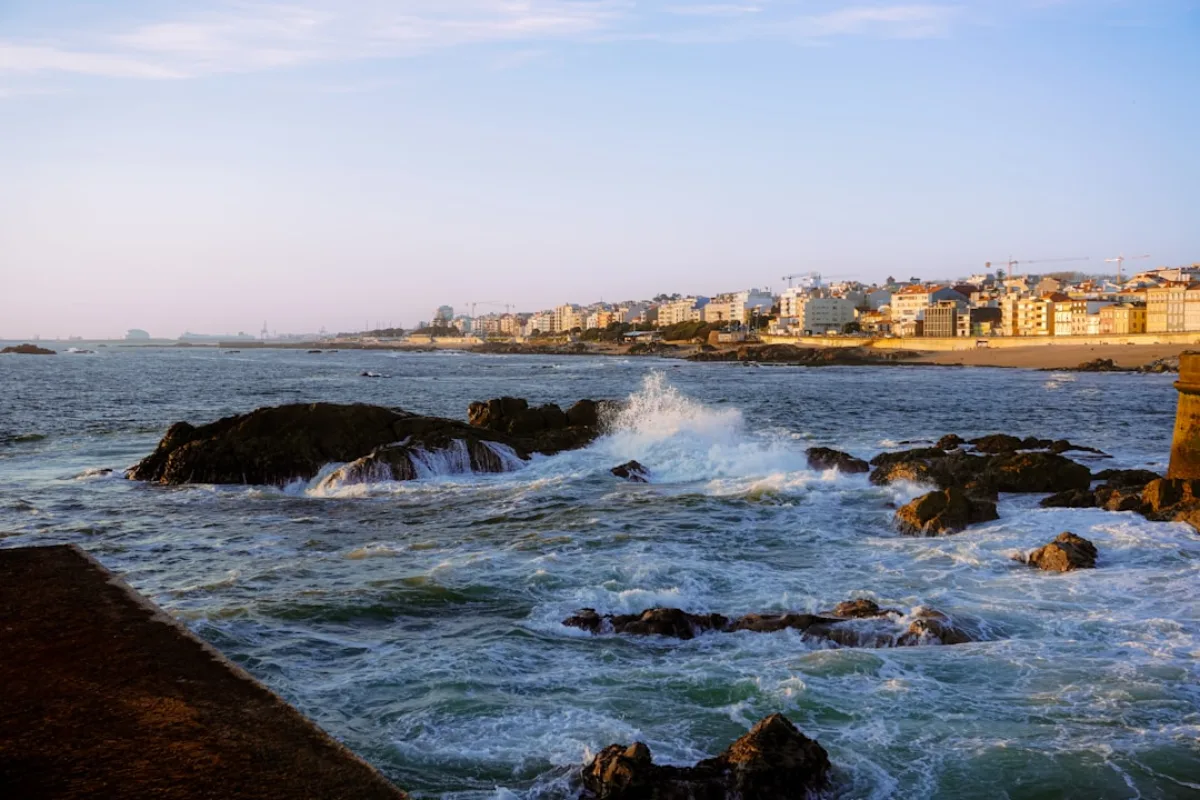
Where the Douro meets the Atlantic — a residential neighborhood 8 km from the old city with a continuous coastal promenade, fish restaurants, and the lighthouse at the river mouth. The seafood at A Grade (fish market restaurant) is the best in the greater Porto area. Accessible by the historic tram (line 1, €3) from the Ribeira.
Practical Notes
- From Lisbon: 3 hours by Alfa Pendular express train (€25–45 booked in advance) or 1 hour by domestic flight. Porto is a very viable 2–3 night extension from Lisbon
- Getting around: Metro connects the airport to the center (€2.60, 35 minutes). The old city is entirely walkable but extremely hilly. Uber and Bolt for cross-city trips
- Accommodation: Ribeira for the views and atmosphere; Baixa for convenience; Bonfim for the local neighborhood feel
- Best time: May–October. The summer festival of São João (June 23–24) is one of the best street festivals in Portugal
Plan your trip