Sintra: Fairy-Tale Palaces & the Atlantic Serra
Plan your trip
Sintra is 40 minutes from Lisbon by train and occupies a wooded mountain ridge above the Atlantic coast — the cool, mist-drenched air, the dense vegetation, and the presence of multiple extraordinary palaces within a few kilometers of each other led Lord Byron to call it “glorious Eden” in Childe Harold’s Pilgrimage (1812), and UNESCO to designate it a Cultural Landscape in 1995.
The site is one of the most concentrated collections of 19th-century Romantic architecture anywhere — palaces built by Portuguese royalty and aristocracy as summer retreats, each trying to outdo the previous in fantasy and eccentricity. It is simultaneously one of the most crowded day trips from Lisbon (July–August can be overwhelming) and genuinely extraordinary.
Palácio Nacional da Pena
The defining image of Sintra — a 19th-century Romantic palace on the highest peak of the Serra, painted in yellow and red, with a mixture of Gothic, Moorish, Manueline, and Renaissance decorative elements that makes it look simultaneously like a Bavarian fairy tale and a Portuguese fantasia. Built for King Ferdinand II between 1840 and 1854 on the ruins of a 16th-century monastery.
The interiors are preserved as they were in 1910 when the royal family fled the Republican revolution — furniture, porcelain, and personal effects intact. The walk-up from the ticket office to the palace gates is steep (15 minutes); a shuttle runs for €3.50. The surrounding park (500 hectares) has more palaces, ferneries, and landscaped paths.
Entry: €22 for palace + grounds. Book online in advance — the ticket queue is long, the online queue is not. Open daily 9:30 AM–7 PM (last entry 6:30 PM).
Castelo dos Mouros (Moorish Castle)
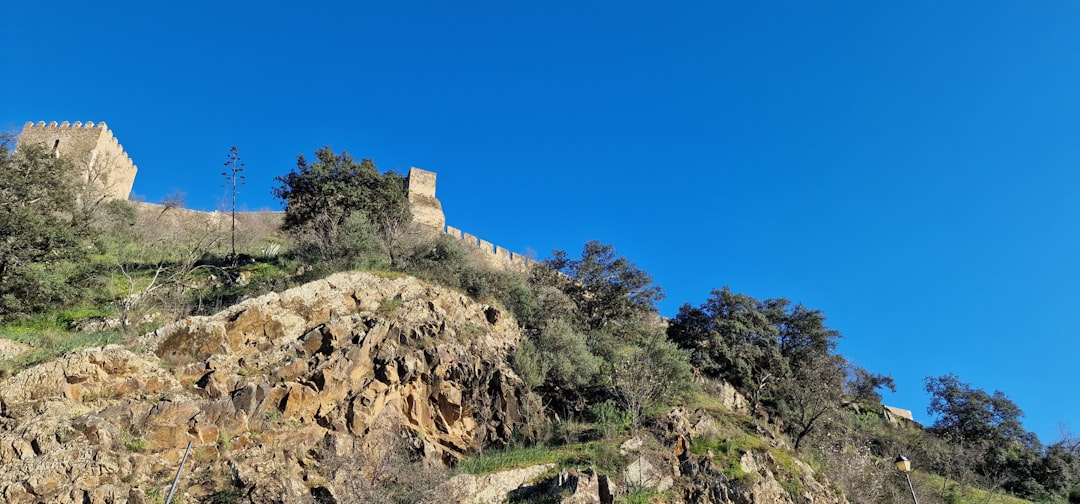
Built by Moorish forces in the 8th–9th centuries, captured by Alfonso I in 1147 — the ruined battlements run along the ridge above Sintra village, with towers at intervals and views over the Atlantic to the west and the Tagus to the southeast. The castle is not reconstructed; the walls are exactly as intact as they remained after centuries of abandonment.
The walk from Sintra village takes 40 minutes through dense woodland. Alternatively, shared taxi (tuk-tuk or taxi) from the village. Entry: €12. The best photography at the castle is from the highest tower, looking across at the Pena Palace on the adjacent peak.
Quinta da Regaleira
A 19th-century estate built by a wealthy eccentric (António Augusto Carvalho Monteiro, known as “Monteiro the Millionaire”) — the palace, gardens, and underground tunnels are decorated with Masonic, Knights Templar, Rosicrucian, and alchemical symbolism. The initiation well (a spiral staircase descending 27 meters into the earth, with Templar crosses at the base) is the most photographed single element, but the entire estate is a designed landscape of hidden meanings.
Entry: €15. Allow 2 hours minimum to explore the underground tunnels and gardens. The estate is not on the Sintra hill above the village — it’s a 10-minute walk from the train station, lower than the other palaces.
Palácio Nacional de Sintra
The royal palace in the center of the village — the twin conical chimneys that rise above the rooftops of Sintra are this palace, visible from every viewpoint in the area. Built over the 14th–16th centuries as the principal royal residence (the Moors had a palace on the site before it), the interior has original Manueline stonework and the finest azulejo-tiled rooms in Portugal outside of Lisbon.
Entry: €12. Often less crowded than the hill palaces because it doesn’t have the dramatic hilltop setting.
Cabo da Roca
15 km west of Sintra — the westernmost point of mainland Europe (and of the Eurasian continent), a 140-meter sea cliff with an 18th-century lighthouse. The drive or bus from Sintra takes 30 minutes. The landscape is Atlantic heath — low scrub, wind, and the sense of being at the edge of the known world that Camões addressed in Os Lusíadas.
Practical Notes
- Getting there: Sintra line train from Rossio station in Lisbon — 40 minutes, €2.35. Trains run every 20 minutes
- Getting around Sintra: Bus 434 loops Sintra village — Moorish Castle — Pena Palace (€5 day ticket). Shared tuk-tuks for flexibility. The walk up is possible but steep (40–60 minutes)
- Order of visits: Pena Palace first (most visited, book timed entry), Moorish Castle next (connected by path), Sintra National Palace in the afternoon (village-level, no hill climb)
- Crowds: July–August requires online booking for all sites and an early train (first departure before 9 AM). October–November is the best period — good light, minimal crowds, the woodland turning
Plan your trip