George Town Guide: UNESCO Heritage, Street Art & Penang's Soul
Plan your trip
George Town is one of the best walking cities in Southeast Asia — a UNESCO World Heritage city where Malay, Chinese, Indian, and British colonial cultures have layered over each other for 230 years, producing a density of temples, mosques, shophouses, clan associations, and street food stalls that rewards hours of aimless wandering. The street art trail added in 2012 turned an already excellent heritage city into an international destination — the steel rod sculptures by Ernest Zacharevic and the wall murals that followed have become some of the most-photographed urban art in Asia.
George Town was inscribed as a UNESCO World Heritage Site in 2008, alongside Malacca (Melaka), for its “outstanding universal value” as a trading port city. The designation has largely protected the historic core from the development pressure that has damaged similar cities elsewhere in Southeast Asia.
The Heritage Core
The UNESCO core zone covers the oldest part of George Town — roughly the area bounded by the waterfront, Penang Street (Jalan Penang), and the intersection with Macalister Road. Almost everything within this zone is navigable on foot.
Armenian Street (Lebuh Armenia)
The center of the street art experience and one of the most photogenic streets in Malaysia. Ernest Zacharevic’s 2012 mural “Children on a Bicycle” (showing two children on an actual rusted bicycle attached to the wall) sparked the street art movement here; the street now has a dozen major works.
The steel rod sculptures along Armenian Street and adjacent lanes are equally worth finding — two-dimensional figures made from iron rods that depict street scenes and occupations from George Town’s past (a trishaw driver, a carpenter, a woman hanging laundry). They’re small, easy to miss, and scattered across the heritage core.
Map: The official George Town World Heritage Inc. street art map is available at the Penang Global Ethic Project on King Street or downloaded at heritagejagapenang.com.
Khoo Kongsi
Cannon Square | Open daily 9 AM–5 PM | Entry: RM10
The most elaborate Chinese clan house (kongsi) in Penang — a temple-courtyard complex built by the Khoo clan (a major Hokkien family) in 1906. The scale is extraordinary: a grand ceremonial courtyard framed by carved pavilions, with a temple hall whose roof decoration — ceramic figures, gilded carvings, painted murals — represents years of artisan work. The Khoo clan’s power and wealth at the height of the Straits Settlements era is made physical here.
The kongsi (clan association) system was the social foundation of Chinese immigrant life in the Straits — providing welfare, dispute resolution, employment, and cultural continuity for new arrivals. The Khoo Kongsi is the most complete surviving example in Southeast Asia.
Kapitan Keling Mosque
George Town’s most important mosque — built in 1801 by Indian Muslim traders, the “Kapitan Keling” (Captain of the Keling, a colonial term for South Indian traders). The current building is a later Mughal-influenced reconstruction, with white domes and minarets. Non-Muslim visitors are welcome outside prayer times; modest dress required (provided at the entrance).
Sri Mahamariamman Temple
Adjacent to the mosque — a Hindu temple serving the Tamil community, with a dramatic gopuram (towered gateway) covered in brightly painted deities. The proximity of the mosque, Chinese clan house, and Hindu temple within 200m of each other on a single street is one of George Town’s defining characteristics.
Penang Peranakan Mansion
39 Church Street | Entry: RM50
A restored Peranakan (Straits Chinese) townhouse demonstrating the material culture of the baba-nyonya community — the Chinese merchant families who adopted Malay cultural elements over generations, producing a hybrid culture unique to the Straits Settlements. The house is filled with Peranakan furniture, porcelain, clothing, and daily objects; the guided tour explains the social context.
The Peranakan aesthetic — green and blue Victorian tiles, carved rosewood furniture, embroidered kebaya blouses — is one of the most distinctive visual cultures in Southeast Asia.
The Clan Jetties (Chew Jetty)
At the waterfront, south end of Weld Quay
A network of wooden jetties extending into Penang harbor, with Chinese clan communities living in houses built over the water. The Chew Jetty is the most famous and most visited — a village of 70+ homes connected by wooden walkways, with a small temple at the entrance. The Clan Jetties have been continuously inhabited since the 19th century and several families still live here.
The morning (7–9 AM) and evening (5–7 PM) hours are the most atmospheric — daytime can be crowded with tour groups. A 20-minute visit to walk the main jetty and the temple is sufficient; longer if you stop to talk with residents.
Penang Hill
5 km from George Town | Cable car from Air Itam base station | Return: RM30
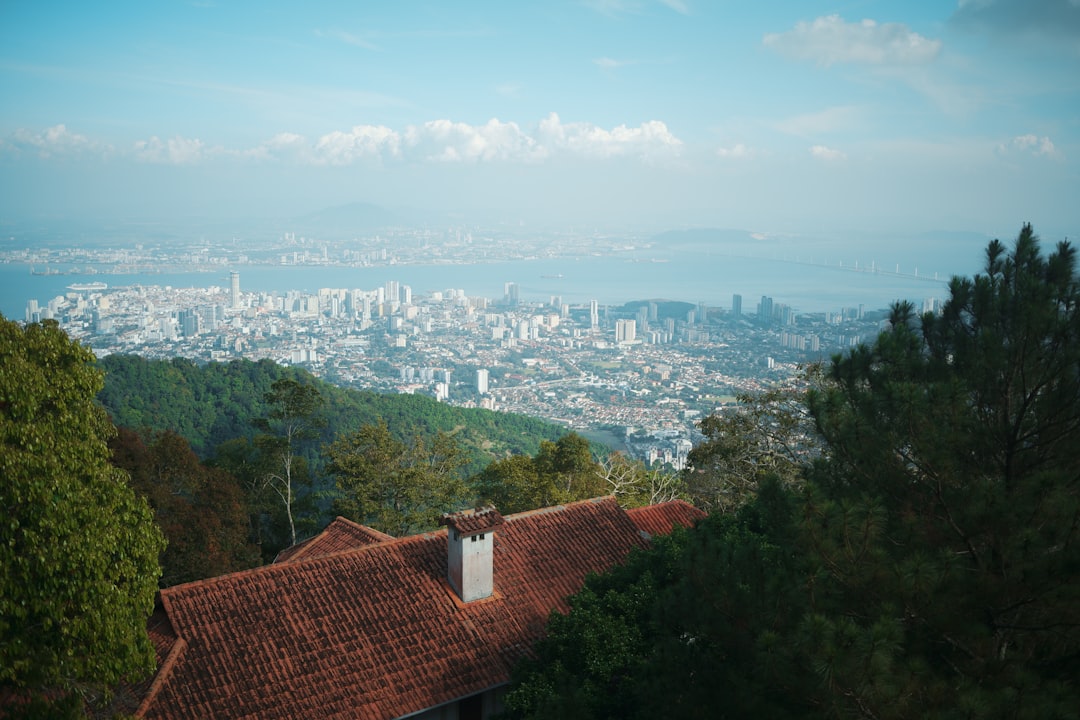
A hill station at 833m offering panoramic views of George Town, the harbor, and the mainland. A funicular railway (rebuilt in 2010, the only one in Malaysia) climbs 6 km in 5 minutes. The summit has gardens, a colonial-era hotel, and a canopy walkway. The temperature is 5°C cooler than the city below — historically a retreat from the coastal heat.
The Habitat Penang Hill: A nature reserve at the summit with guided canopy walks and night tours. The biodiversity on the hill (isolated from the mainland for long enough to develop endemic species) includes several unique species. Canopy walk entry: RM38.
Walking the Heritage Core
Recommended sequence (half-day):
- Start at Fort Cornwallis on the waterfront (the original British fort, now a park) — free to walk the exterior
- Walk along Lebuh Light (Light Street) past the Eastern & Oriental Hotel (1885, still operating)
- Into Armenian Street for the street art
- North to Lebuh Cannon for Khoo Kongsi
- South along Lebuh Pitt (Pitt Street) — “Street of Harmony” with mosque, Hindu temple, and churches within 500m
- Through the Little India zone around Lebuh Pasar Besar
- Down to the Clan Jetties via Weld Quay
Time: 3–4 hours at a leisurely pace, longer if stopping at Khoo Kongsi and the Peranakan Mansion.
Temperature note: George Town at street level in midday heat is significant — 32–36°C with high humidity. The walk is most comfortable before 10 AM or after 4 PM.
Practical Notes
Getting around the heritage core: On foot only — the lanes are too narrow for vehicles in many areas, and the density requires walking speed to appreciate. Trishaw (traditional three-wheeled pedicab) rentals are available for the main streets if walking is difficult.
Accommodation: The heritage core has been converted into boutique hotels occupying restored shophouses — Seven Terraces, Muntri Mews, and 1881 Chong Tian are the most acclaimed. Rooms are small (shophouse architecture), beautifully restored, and expensive relative to mainland Malaysia.
Costs: George Town is notably cheap compared to Kuala Lumpur or international standards. A full hawker meal: RM8–15. Museum entries: RM10–50. Budget guesthouses: RM50–100/night.
Plan your trip