Penang Travel Guide: George Town, Hawker Food & UNESCO Heritage
Plan your trip
Penang is an island state off the northwest coast of peninsular Malaysia — connected to the mainland by two bridges — and its capital George Town is one of the most culturally layered cities in Southeast Asia. For centuries a trading port of the British East India Company, then the Straits of Malacca’s busiest entrepôt, George Town became a melting point of Malay, Chinese, Indian, and European cultures that produced a specific material culture visible in every block: five-foot-way shophouses, Chinese clan temples, mosques and Hindu temples sharing the same street, and a food culture that consistently ranks among the world’s best.
In 2008, George Town was inscribed as a UNESCO World Heritage Site — the recognition of an outstanding example of multicultural heritage in Southeast Asia.
Why Penang
The food: Penang is widely considered Malaysia’s — and arguably Southeast Asia’s — most concentrated hawker food destination. Char kway teow (wok-fried flat noodles), assam laksa (sour tamarind fish soup, completely unlike the coconut-based laksa of KL), nasi kandar (rice with curries, a Mamak Indian-Muslim preparation), cendol (shaved ice with coconut milk, palm sugar, and green jelly), and Hokkien mee (thick prawn noodle soup) are the signature dishes. The prices at hawker stalls: RM 5–12 (~€1–2.50) per dish.
The heritage: The George Town shophouses — two and three-story terraced buildings with a covered walkway (five-foot-way) at street level — were built by Chinese, Indian, and Malay traders between the 1800s and 1940s. Many have been restored; some remain in original inhabited condition with the same families occupying the upper floors that their great-grandparents built. The density of intact heritage architecture is comparable to Havana or Hội An.
The street art: A 2012 commission brought Lithuanian artist Ernest Zacharevic to paint murals on shophouse walls, inaugurating a street art movement that now covers much of the old city. The original murals (Children on Bicycle, Boy on Motorcycle) became the most photographed images in Malaysia; subsequent international and local artists have added hundreds more. The street art map is available at heritage hotels and tourist offices.
George Town: The Core
The Heritage Zone (UNESCO)
A roughly 1.5 km core of shophouses organized by the historical clan and ethnic geography of the settlement: the Chinese clans in the center and east (Tan’s, Khaw’s, Kong’s); Kampong Malabar (the Indian Muslim neighborhood) to the northwest; and Little India around Jalan Masjid Kapitan Keling. Walking between these zones takes 10 minutes but crosses centuries of layered settlement.
Cheong Fatt Tze Mansion (the Blue Mansion): A Chinese merchant’s mansion built in 1880 — 38 rooms, 7 courtyards, stained glass from Glasgow, Chinese tilework from Guangzhou, and cast-iron balustrades from Scotland. One of the finest pieces of Sino-colonial architecture in Asia. Guided tours daily at 11 AM, 2 PM, and 3:30 PM; ~RM 17. Also a boutique hotel (stays require booking months ahead).
Khoo Kongsi Clanhouse: The most elaborate of Penang’s Chinese clan temples — a 1906 building decorated to such an excessive degree (dragon boats on the roof, gilded columns, painted ceiling panels) that the original 1898 building allegedly collapsed under the weight of its ornament. The current version was rebuilt with slightly more restraint. Free entry.
Sri Mahamariamman Temple: The main Hindu temple of George Town, on Jalan Masjid Kapitan Keling — the street that concentrates a Sunni mosque, a Shia mosque, a Hindu temple, and a Chinese temple within 200m of each other.
The Hawker Stalls
Gurney Drive Hawker Centre: The most famous hawker centre in Penang — a large covered area on the waterfront with dozens of stalls. Tourist-accessible but still genuinely good. Best for a first hawker experience where everything is visible and easy to navigate.
Red Garden Food Paradise: The late-night hawker hub in George Town’s center. Active from 6 PM to midnight. More local atmosphere than Gurney Drive.
Lorong Baru (New Lane): The street food street for Penang locals — stalls set up from 6 PM on the road itself, concentrating many of Penang’s most celebrated hawker vendors. Look for the char kway teow stall with a queue extending past neighboring stalls.
Penang Hill (Bukit Bendera)
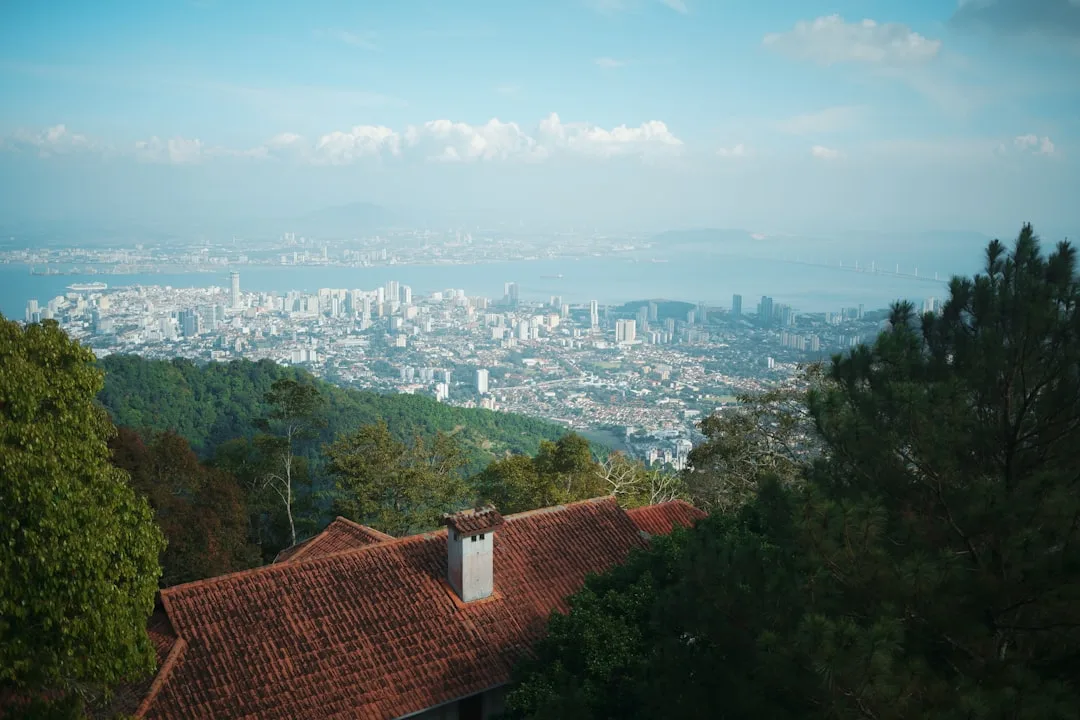
The funicular railway (10 minutes, RM 30 round trip for foreigners) runs to the summit at 830 meters — the temperature drops 4–5°C from sea level, making the hill a traditional retreat from the coastal heat. The views over George Town, the Penang Bridge, and the mainland are the reason to come. The summit has a hotel (The Habitat), a small Belimbing forest walk, and various cafés. A Dawn and Dusk package (including night viewing) is available.
Outside George Town
Kek Lok Si Temple (Air Itam): The largest Buddhist temple in Malaysia — a complex begun in 1891 and still expanding, with a 30-meter bronze statue of Kuan Yin (the Goddess of Mercy) and a pagoda combining Chinese, Thai, and Burmese architectural styles. Free to enter the main complex; fee for the pagoda interior. About 8 km from George Town by Grab.
Batu Ferringhi Beach: The main beach strip on Penang’s north coast, 25 km from George Town. The beach itself is good; the adjacent strip of hotels and restaurants is unremarkable. Better for an afternoon swim than as a destination.
Practical Notes
Getting to Penang: Penang International Airport (PEN) — AirAsia and Malindo Air from Kuala Lumpur (1 hour, from ~RM 60/€12). Alternatively, 4 hours by bus from KL to Butterworth (mainland terminal) + 15-minute ferry to George Town.
Getting around George Town: The UNESCO heritage zone is walkable. The Penang Heritage Trail map covers the main sites. Grab (Uber equivalent) for trips to Penang Hill, Kek Lok Si, or Batu Ferringhi.
Currency: Malaysian Ringgit (MYR/RM). ~€1 = RM 5. Very favorable exchange rate for European visitors.
When to go: November–January (northeast monsoon) brings rain but the food culture is unchanged. March–October is drier. The George Town Festival (July) brings international arts programming.
Accommodation: Heritage hotels in George Town shophouses (Cheong Fatt Tze, Seven Terraces, Macalister Mansion) are the most atmospheric but book up. Budget guesthouses in the heritage zone: RM 60–120/night (€12–24).
Plan your trip