Lahore Historical Guide: Mughal Architecture & the Old Walled City
Plan your trip
Lahore was the Mughal Empire’s second capital and cultural heart — the city where Akbar, Jahangir, and Shah Jahan spent significant periods of their reigns, and where some of the most accomplished Mughal architecture in existence was built. The Lahore Fort (partly UNESCO-listed), the Badshahi Mosque, the Shalimar Gardens, and the Wazir Khan Mosque form an ensemble of 16th–17th century Islamic architecture that rivals anything in Agra, Delhi, or Isfahan.
The Old City (the walled city, Andaroon Lahore) surrounding these monuments is a functioning urban environment — 2 million people living in a medieval street plan, the bazaars still organized by trade as they were under Mughal rule. It’s more challenging to navigate than any comparable site in India or Central Asia, and more rewarding.
Lahore Fort (Shahi Qila)
UNESCO World Heritage Site (partial) | Open daily 8:30 AM–6 PM | Entry: PKR 500 foreign visitors
The imperial Mughal fort — construction began under Akbar in 1566 and continued under Jahangir and Shah Jahan, producing a complex that reflects the evolving Mughal aesthetic from the red sandstone severity of Akbar’s style to the marble-inlaid refinement of Shah Jahan’s.
Key Structures
Sheesh Mahal (Palace of Mirrors): Shah Jahan’s pleasure pavilion, the interior of which is covered entirely in mirror mosaic — a technique called aina kari — producing a surface that reflects candlelight into thousands of points. One of the finest examples of this technique anywhere. The Sheesh Mahal’s cool marble interior on a Lahore summer day is among the most pleasant spaces in the fort.
Diwan-i-Aam (Hall of Public Audience): Where the Mughal emperor held public audiences — a colonnaded pavilion where the jharoka (window) from which the emperor showed himself to the public is still visible. The proportions are designed to make the seated emperor appear elevated and remote.
Alamgiri Gate: The main entrance gate, built by Aurangzeb in 1673 — two octagonal towers flanking the entrance portal, the marble panels and geometric tilework representing the late Mughal style. Faces the Badshahi Mosque directly across Hazuri Bagh (the garden square between them).
Jahangir’s Quadrangle: The oldest surviving section of the fort in its current form — a courtyard surrounded by rooms built by Jahangir for his court. The frescoes in the surrounding rooms (depicting hunting scenes, the royal court, and Persian mythology) are among the most extensive Mughal wall painting cycles remaining.
The Lahore Fort Museum: Within the fort complex — collections of Mughal weapons, coins, and miniature paintings. Variable display quality but some excellent pieces.
Badshahi Mosque
Beside Lahore Fort | Free entry | Modest dress required; women must cover hair
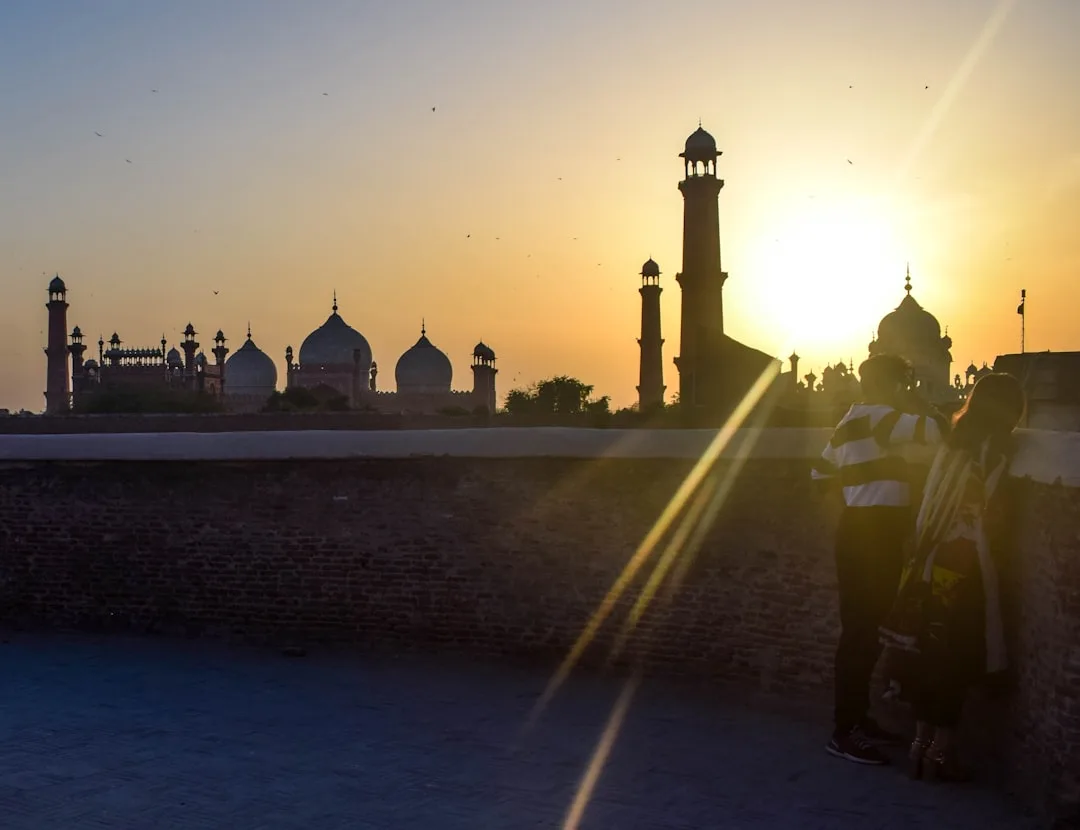
Built by Aurangzeb in 1673 — the last great Mughal monument in Lahore and, at its completion, the largest mosque in the world (a record held until 1986). The statistics: 10,000 worshippers in the main prayer hall, 100,000 in the courtyard. The red sandstone exterior, white marble domes (three main domes flanked by four minarets), and the vast open courtyard create a monument of deliberate imperial scale.
The approach: From the Alamgiri Gate of the fort, cross Hazuri Bagh (the garden square with a marble platform in the center — the Hazuri Bagh Baradari, built by Ranjit Singh for musical performances) to the mosque entrance. The sequence — fort gate, garden, mosque gate — is the ceremonial approach Aurangzeb intended.
The interior: The prayer hall is decorated with white marble incised with floral patterns and calligraphy. The three domes above the hall are the prayer hall’s ceiling; the acoustic properties (designed to amplify the call to prayer) are noticeable.
The museum: A small museum in the mosque’s gatehouse contains historical objects including the Prophet Muhammad’s relics (hairs, a cloak, and sandals — among the most revered objects in South Asian Islam). Visiting requires modesty and awareness of the sacred context.
Wazir Khan Mosque
In the Old City, 15 minutes walk east of the Fort | Free entry | Open to non-Muslims outside prayer times
Less famous than the Badshahi Mosque but arguably the more beautiful — a smaller mosque (built 1634–1635 under Jahangir’s governor Wazir Khan) whose surface is covered entirely in kashi kari (tile mosaic work) of extraordinary complexity and color. The courtyard walls, minarets, and the prayer hall facade are covered in intricate geometric and floral patterns in turquoise, ultramarine, white, yellow, and green.
The Wazir Khan Mosque is embedded in the Old City’s street fabric — you approach through narrow bazaars (Kasera Bazaar, the brass workers’ market), and the mosque appears suddenly through an arched gateway. The contrast between the chaotic market lanes and the serene tiled interior is dramatic.
The kashi kari work: The tile technique is Persian in origin, brought by craftsmen who traveled with the Mughal court. The specific density of decorative surface at Wazir Khan — not a centimeter of wall left plain — represents the high point of Mughal surface decoration in Lahore.
Shalimar Gardens
5 km east of the Old City | Open daily 6 AM–10 PM | Entry: PKR 400
UNESCO World Heritage Site (partial; affected by encroachment)
The Mughal garden of Shah Jahan (completed 1641) — three terraced levels descending from the Kashmiri Canal, with 410 fountains fed by the canal, marble pavilions, and the chaharbagh (four-fold garden) layout that organizes the garden geometrically with water channels as dividing axes.
The garden has been affected by urban encroachment and the surrounding neighborhood has grown significantly; the outer walls and some structures have been altered. But the central terraces and the fountain system are intact, and on a clear morning before the temperature rises, the combination of moving water, marble, and the geometric plantings creates one of the most refined spaces in Lahore.
Best time: Early morning (6–8 AM), when the garden opens and temperature is low. The fountains operate during daylight.
The Old City Walking Route
The Old City (Andaroon Lahore) is organized around the Delhi Gate–Royal Bazaar–Fort axis — the main processional route of Mughal Lahore.
Suggested sequence:
- Enter through Delhi Gate (one of the 13 original city gates; this one reconstructed)
- Walk along Shahi Guzargah (Royal Bazaar) — the processional road used for Mughal ceremonial occasions
- Detour to Wazir Khan Mosque via Kasera Bazaar
- Continue to Fort / Badshahi Mosque axis
- Walk back through the inner bazaars (Suha Bazaar, Mochi Gate) toward the afternoon food streets
Guides: A guide is strongly recommended for the Old City — the street network is complex, the historical context significantly enriches what you’re seeing, and a local guide connects you to individual craftspeople and shopkeepers along the way. Arrange through a Lahore tour operator or your hotel.
Data Darbar (Shrine of Data Ganj Bakhsh)
1 km from the Fort | Open 24 hours | Free
The most important Sufi shrine in Pakistan — the tomb of Ali Hujwiri (Data Ganj Bakhsh, died approximately 1077 CE), one of the earliest Sufi missionaries in South Asia. The shrine is a continuous 24-hour pilgrimage site: hundreds of devotees at any hour, qawwali music performed at the shrine on Thursday evenings, and the specific atmosphere of Sufi devotional practice that has been maintained at this site for nearly a millennium.
Visiting a Sufi shrine in the context of active pilgrimage is one of the most powerful cultural experiences available in Pakistan — the music, the devotion, and the specific form of Islamic practice are entirely different from the formal mosque context.
Plan your trip