Lahore Travel Guide: Mughal History, Food & the Heart of Pakistan
Plan your trip
Lahore is Pakistan’s cultural capital — and by most measures, one of the most historically layered cities in South Asia. For over three centuries, it was the second city of the Mughal Empire, producing monuments that rank among the finest examples of Islamic architecture in the world. The Lahore Fort, the Badshahi Mosque, the Shalimar Gardens, and the Wazir Khan Mosque are all here — and all are dramatically undervisited by Western travelers who haven’t yet discovered that Pakistan’s major monuments are, for now, accessible at a fraction of the cost and crowds of their equivalents in India.
The Mughal Monuments
Lahore Fort (Shahi Qila)
Hazuri Bagh, Walled City | Open daily
The fortress-palace of the Mughal emperors, continuously expanded from Akbar’s reign (late 16th century) through Aurangzeb (late 17th century). The complex covers 20 hectares and contains 21 notable monuments — the Sheesh Mahal (Palace of Mirrors), the Naulakha Pavilion, the Moti Masjid (Pearl Mosque), and the Diwan-i-Aam (Hall of Public Audience).
The Sheesh Mahal is the most celebrated interior — walls and ceiling covered entirely in convex mirror fragments set in plaster, creating a shattered-light effect when a single candle is lit in the room. The original Mughal effect can be approximated with a phone torch.
The Hazuri Bagh (garden between the fort and the Badshahi Mosque) is framed by the Ranjit Singh Baradari — a marble pavilion built by the Sikh Maharaja Ranjit Singh in 1818.
Entry: ~PKR 500 for foreigners. Allow 2.5–3 hours.
Badshahi Mosque
Directly facing the Lahore Fort | Open to visitors outside prayer times
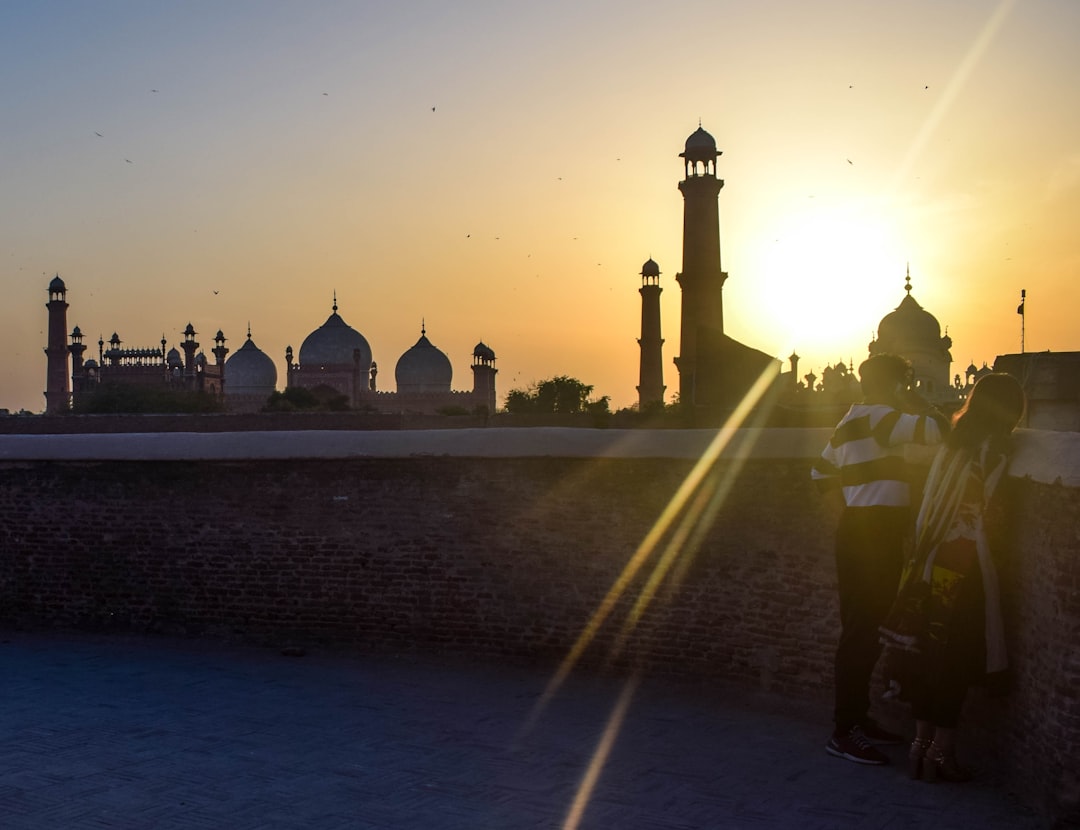
Built by Aurangzeb in 1673 — for nearly 300 years the largest mosque in the world (now fourth largest). The red sandstone exterior with white marble inlay, the three white marble domes, and the four octagonal minarets create one of the most photographed religious buildings in Asia. The courtyard holds 100,000 worshippers.
Entry is free for non-Muslim visitors outside prayer times; shoes must be removed, and headscarves are available at the entrance for women. The atmosphere during the Friday prayer call — when the muezzin’s voice echoes across the courtyard — is extraordinary.
Wazir Khan Mosque
Inside the Walled City, near Delhi Gate
Built in 1634 during Shah Jahan’s reign — considered the finest example of Mughal tile-work surviving anywhere. The interior and exterior surfaces are covered in kashi kari (faience tile work) in extraordinarily intricate geometric and floral patterns in turquoise, cobalt, yellow, and white. Less visited than the Badshahi Mosque and far more intimate. The bazaar surrounding it (Bazaar of the Jewellers, Bazaar of the Potters) has been operating continuously since the Mughal period.
Shalimar Gardens
Grand Trunk Road, northeast of the Walled City | UNESCO World Heritage Site
A three-tiered Mughal garden designed in 1641 on the orders of Shah Jahan — a formal Persian-style garden with fountains, water channels, marble pavilions, and 400-year-old trees. The garden was designed as a pleasure garden for the Mughal court; the terracing allows each level to function as a separate garden.
The Walled City (Androon Lahore)
The old city within the Mughal-era walls — 13 original gates, of which six survive (Delhi Gate, Lahori Gate, and others). The lanes inside are among the densest urban fabric in Asia: workshops producing traditional items (metalwork, leather, cloth), mosques in every block, havelis (courtyard houses) from the Mughal and Sikh periods, and the continuous noise and commerce of a city that has operated at this density for four centuries.
Best approach: Enter via Delhi Gate and walk to Wazir Khan Mosque (10 minutes). From there, follow the bazaars toward the Lahore Fort. The walk through the food and spice markets is dense, noisy, and — depending on your tolerance for sensory intensity — either exciting or overwhelming.
The Food Street (Gawalmandi): A curated outdoor dining area in the old city — restored haveli facades and street-level restaurant seating, most active from 7 PM onward. Traditional Lahori dishes: nihari (slow-braised beef shank), paye (trotters), karahi (a wok-cooked meat and tomato preparation), and Lahori fried fish. The food is heavy, oily, and excellent.
Sufi Music at Data Darbar
Data Darbar Shrine, near Bhati Gate | Active from evening, peak Thursday nights
The shrine of Ali Hujwiri (Data Ganj Bakhsh), the 11th-century Sufi saint who introduced Islam to the Punjab — the largest Sufi shrine in South Asia. The Thursday evening qawwali (devotional music) sessions are one of the most powerful musical experiences in Pakistan: professional qawwali singers performing the devotional repertoire to a crowd of devotees, pilgrims, and visitors in a courtyard that can hold thousands.
Non-Muslim visitors are generally welcomed respectfully. Women should cover heads and shoulders; everyone removes shoes at the gate. The atmosphere shifts from meditative to ecstatic as the evening progresses.
Practical Notes
Getting to Lahore: Allama Iqbal International Airport (LHE) with connections from Dubai, London, and major Asian hubs. Lahore is also connected by the Grand Trunk Road and Lahore–Islamabad Motorway (3.5 hours by car or bus).
Getting around: Rickshaws (negotiate fare before riding; PKR 100–300 for most inner-city trips) or the Lahore Metro (Orange Line, opened 2020). The Walled City and main monuments are concentrated enough that walking is possible for a half-day.
Currency: Pakistani Rupee (PKR). ATMs available widely; carry cash for small purchases.
Weather: Best months are October–March (15–25°C). Summer (May–September) is extremely hot (40–45°C possible in June).
Visa: Check current visa-on-arrival and e-visa availability for your nationality before booking. Pakistan has expanded its e-visa program considerably since 2022.
Plan your trip