Sagrada Família: The Complete Visitor's Guide (2026)
Plan your trip
The Sagrada Família is the most visited monument in Spain and one of the most significant architectural works in the world. Designed by Antoni Gaudí, construction began in 1882 and the basilica has been continuously built for over 140 years. In 2026 — coinciding with Barcelona’s designation as UNESCO World Capital of Architecture — the central tower, the Torre de Jesucrist, reaches its full height of 172.5 meters, making the Sagrada Família the tallest church in the world.
Visiting in 2026 means witnessing the near-completion of a project that will have taken six human generations.
Booking Tickets
Book at sagradafamilia.org — never from third-party resellers. The basilica operates on timed entry slots, and popular times (mornings, weekends, summer) sell out weeks in advance. In high season (June–September), booking 3–4 weeks ahead is advisable.
Ticket options:
- Basic entry (~€26): Access to the basilica interior. No tower access.
- Entry + tower access (~€36–40): Includes one of the towers — either the Nativity Tower (east façade, accessible by elevator + stairs) or the Passion Tower (west façade). Tower tickets sell out first.
- Guided tour add-on (~€13): A 50-minute guided audio or live tour. Useful for understanding the symbolism.
- Top of the Basilica experience (~€50+): Access to the roof terraces, added in recent years for closer views of the tower structures.
Best time to book: The first entry slot (9 AM) has the most light in the interior and the smallest initial crowds. Early morning on weekdays is the most comfortable experience.
The Two Façades
Nativity Façade (east, facing Carrer de la Marina): The only façade completed during Gaudí’s lifetime (1894–1930). Depicts the birth and childhood of Jesus through dense, organic stone sculpture — figures that seem to grow from the wall. The detail at close range is extraordinary; step back to see the full composition. The four towers of this façade are the oldest.
Passion Façade (west, facing Carrer de Sardenya): Designed by Josep Maria Subirachs after Gaudí’s death, completed in stages from the 1980s onward. Deliberately severe and angular — a deliberate contrast to the Nativity’s organic exuberance. Depicts the crucifixion and death of Christ. Controversial but powerful; the geometric figures have their own brutal logic.
Glory Façade (south, main entrance, under construction): The main façade Gaudí intended as the primary entrance — still under construction. When complete, it will be the largest of the three.
The Interior
The interior completed its nave ceiling in 2010. Walking in for the first time is a spatial shock — the tree-column system (columns that branch into vaulted canopies like a stone forest) creates a ceiling that fractures and filters light in ways no conventional Gothic interior does.
The light: The stained glass windows are the defining experience of the interior. The east windows (sunrise side) are in warm amber and gold; the west windows are cooler blues and greens. The quality of light shifts dramatically throughout the day. Morning visits catch the full Nativity side light pouring into the nave.
The columns: Gaudí developed a system of branching columns based on hyperboloids and paraboloids — mathematical curves that distribute structural loads without the need for external flying buttresses. Each column is made of different stone: granite, basalt, porphyry, and limestone, each with a different structural load rating, placed in corresponding positions.
The crypt: Gaudí is buried in the crypt beneath the apse. The tomb is visible through a glass panel. He died in 1926 (struck by a tram, initially unrecognized due to his simple dress) and was buried in the basilica he spent the last 40+ years of his life building.
The Towers in 2026
The completed basilica will have 18 towers of three distinct heights:
- 4 Evangelist towers (Matthew, Mark, Luke, John) — surrounding the central tower
- Tower of the Virgin Mary — 138 meters, completed in 2021
- Torre de Jesucrist — 172.5 meters, completed 2026. The tallest church tower in the world.
- 12 Apostle towers — flanking the three façades (most completed)
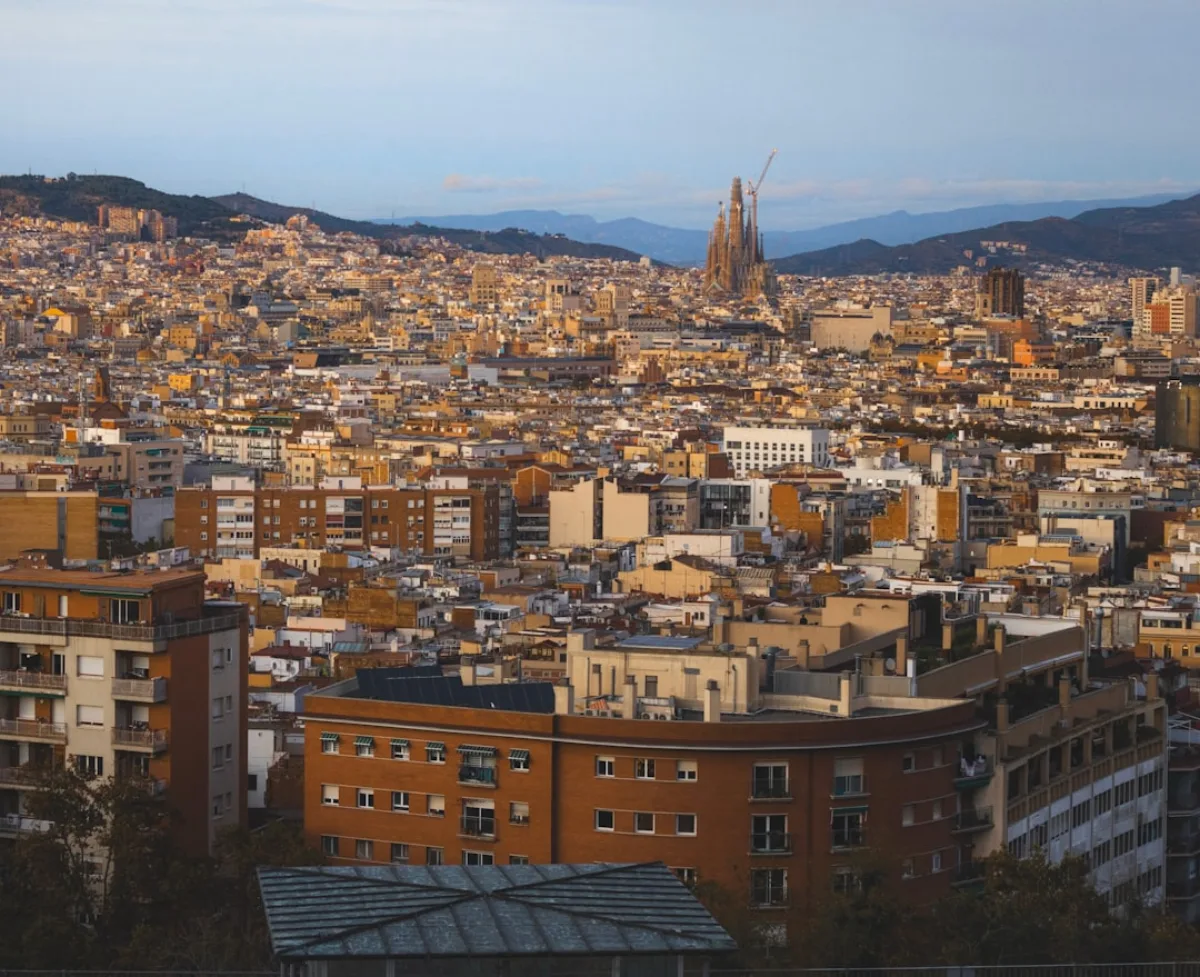
Visiting in 2026: the skyline of Barcelona changes definitively with the central tower’s completion. Views from the Nativity or Passion towers now look directly across at the finished central spire.
Practical Details
Address: Carrer de Mallorca, 401, Eixample. Metro: Sagrada Família (Lines L2 and L5) — a 2-minute walk.
Hours: Generally 9 AM – 8 PM (summer), 9 AM – 6 PM (winter). Verify at sagradafamilia.org.
Time needed: Budget 2–3 hours for a thorough visit including tower access. With a guided tour, 3.5 hours.
Photography: Permitted throughout. The interior light is best photographed with a wide-angle lens pointed at the ceiling. No flash.
Crowds: The basilica receives 4+ million visitors per year. Even with timed entry, the interior is rarely quiet. The first slot of the day and late afternoon slots are the least crowded.
Plan your trip