Kenroku-en and the Best of Kanazawa
Plan your trip
Kanazawa was Japan’s wealthiest domain outside of Edo during the Edo period. The Maeda clan — who governed this territory for 270 years from 1583 — spent their money on art, craft, theater, and gardens rather than military campaigns, because military campaigns would have attracted the attention of the shogunate in Tokyo. The result: a city with extraordinary cultural accumulation, preserved districts that Kyoto’s postwar development largely destroyed, and crafts traditions (Kaga Yuzen silk dyeing, Wajima lacquerware, Kutani porcelain, gold leaf) that still operate today.
The bullet train from Tokyo reaches Kanazawa in 2.5 hours (Hokuriku Shinkansen). From Osaka or Kyoto, the Thunderbird limited express runs 2-2.5 hours. It is consistently undervisited by foreign tourists who make the Kyoto-Osaka circuit and stop there. This is their mistake.
Kenroku-en Garden
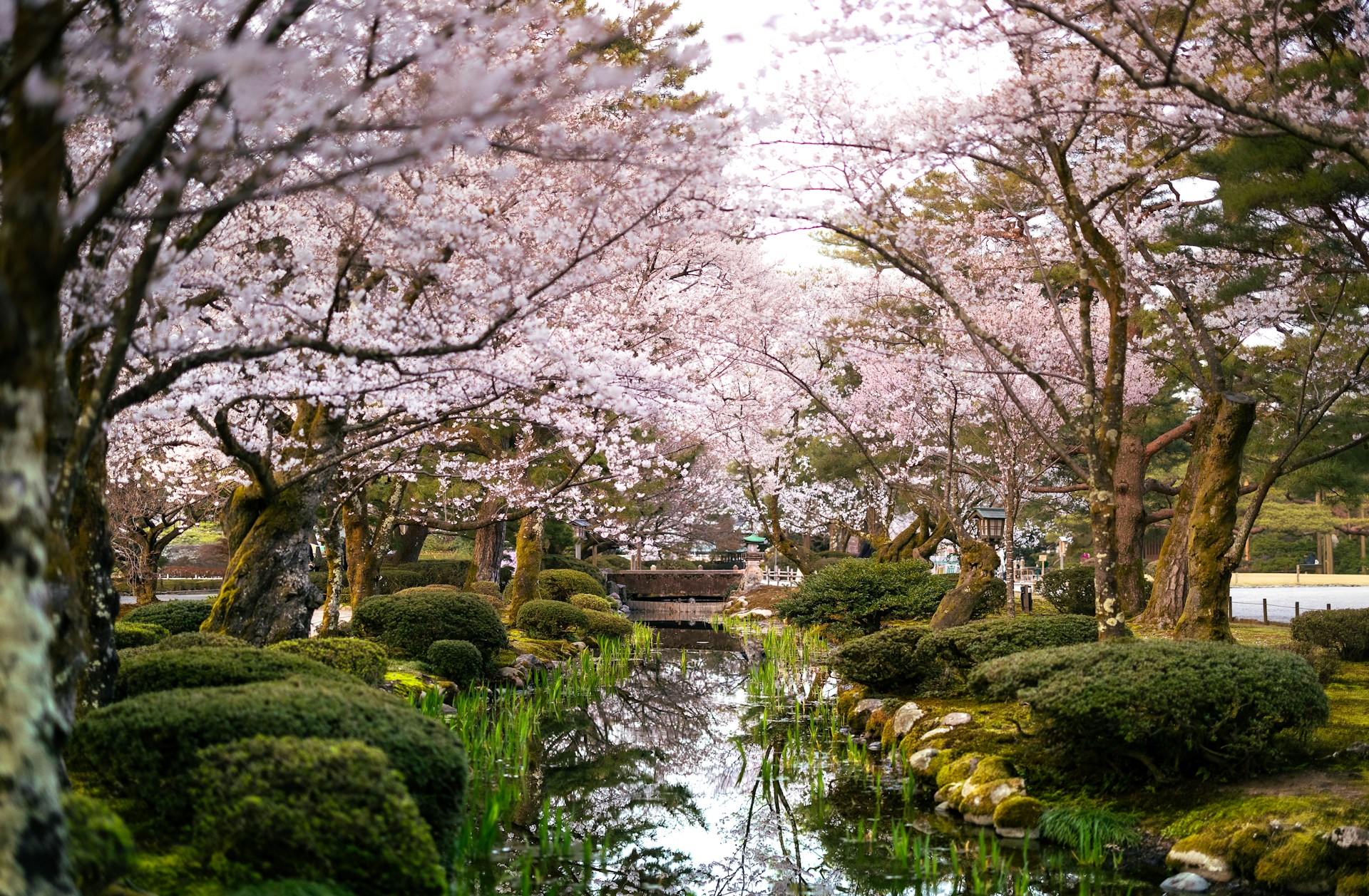
The most visited site in Kanazawa and one of Japan’s three great gardens. The name comes from a Song dynasty Chinese text listing the six attributes of a perfect garden: spaciousness, seclusion, artifice, antiquity, water courses, and panoramas. Kenroku-en has all six because it was built over 170 years by successive Maeda lords, each adding new elements.
The garden occupies 11.4 hectares adjacent to Kanazawa Castle. Key features:
Kotoji-toro: The two-legged stone lantern standing in Kasumigaike pond — the image most associated with Kenroku-en. One leg is taller than the other; the design reflects the koto bridge of a Japanese harp. The lantern in morning mist or at dusk is the photograph that appears on every Ishikawa tourism brochure.
Karasaki-no-matsu: An 1881 black pine of enormous size, with branches spreading over 22 meters supported by yukitsuri — a system of conical rope supports strung from a central pole. In winter, these ropes protect the branches from snow damage and create one of Kanazawa’s most iconic winter images.
Yugao-tei and Machiai-tei teahouses: Two original tea houses from the Edo period, still intact. The Yugao-tei (1774) overlooks a private pond. Both can be entered for tea service.
Seasonal highlights: Plum blossoms in late February, cherry blossoms in April, irises in June, and the yukitsuri ropes installed in mid-November for the winter season (lasting until March). Each season gives the garden a fundamentally different character.
Admission: ¥320. The east gate entrance (closest to Higashi Chaya) is less crowded than the main entrance.
Higashi Chaya — The Preserved Geisha District
Kanazawa has three geisha districts (hanamachi), of which Higashi Chaya (East Tea House District) is the most intact. The main street — a single block of two-story lattice-windowed machiya houses — has been preserved largely unchanged since the early 19th century. Kanazawa’s geisha tradition operates similarly to Kyoto’s: teahouses (ochaya) where geisha perform and entertain private parties, accessible by introduction only.
The street itself is publicly walkable. Several of the historic ochaya are open as museums or cafes:
Shima Ochaya: A preserved geisha house from 1820, open as a museum (¥500). The interior rooms — guest receiving areas, the geisha’s preparation rooms, and the garden — are intact with original furnishings and instruments.
Kaikaro: Still operating as an ochaya. The first floor is open as a cafe and gallery for limited hours.
Gold leaf crafts: Kanazawa produces 99% of Japan’s gold leaf. The Higashi Chaya district has workshops and shops selling gold leaf-covered goods: chopsticks, lacquerware, cosmetics, food products. Hakuichi and Hakuza are the main established shops.
Kanazawa Castle Park and the Museum
Kanazawa Castle was repeatedly destroyed by fire and never fully rebuilt; the current complex is partially restored. The stone walls, however, are original and represent one of the finest examples of Edo-period military architecture in Japan — the variety of stone-laying techniques visible on a single wall is extraordinary to specialists and visually compelling to anyone who pays attention.
Adjacent to the castle, 21st Century Museum of Contemporary Art, Kanazawa (Kanazawa 21) is Japan’s most important contemporary art museum outside Tokyo. The circular building designed by SANAA (Sejima and Nishizawa) sits embedded in an open park with no formal front or back entrance — you approach from any direction, and the building appears as if it has settled into the landscape.
The permanent collection includes work commissioned specifically for the museum’s unusual spaces. The most famous piece: Leandro Erlich’s “Swimming Pool” — an installation that creates the optical illusion of a pool with swimmers from above and a dry chamber with visible feet from below. The museum’s temporary exhibitions change seasonally.
Admission to permanent collection: portions are free; charged exhibitions vary. The architecture and outdoor installations are accessible without tickets.
Samurai Districts
Nagamachi (samurai district) sits west of Kenroku-en — a maze of earthen-walled lanes, stone drainage channels, and preserved samurai houses. Several are open as museums:
Nomura Samurai House: The most complete preserved samurai residence in the city, with a refined garden visible from the reception rooms. The family’s equipment, armor, and documents are displayed. ¥600.
Saihitsuan Yuzen Silk Center: A workshop demonstration of Kaga Yuzen — the silk-dyeing technique unique to Kanazawa, characterized by its five traditional colors and hand-drawn designs of natural motifs (flowers, birds, landscapes). Workshop participation available with advance booking.
Omicho Market
The largest covered market in Hokuriku, established over 300 years ago. Omicho Ichiba sells the seafood of the Sea of Japan coast — snow crab (Zuwaigani, in season November-March), yellowtail (buri), sweet shrimp (ama-ebi), and sea cucumber (namako) among the specialties. Several restaurants operate inside the market serving the morning’s purchases; lunch here, particularly in crab season, represents excellent value.
Nishi Chaya and Kazuemachi
Two smaller geisha districts worth visiting for quieter versions of the Higashi Chaya experience. Nishi Chaya (West Tea House District) is a single row of preserved machiya with craft shops and a small museum (Nishi Chaya Shiryokan). Kazuemachi runs along the Asanogawa canal — particularly atmospheric in early morning or rain, when the reflection of the machiya in the water is visible.
Food in Kanazawa
Kaga cuisine (Kaga ryori) is the regional cooking style — elaborate, multi-course, built around the seasonal fish and vegetables of Ishikawa Prefecture. At its full expression it requires a kaiseki dinner at an established restaurant (¥15,000+). More accessible versions appear at lunch in the market area.
The Kanazawa curry: A regional fast-food category unique to the city — thick brown curry served with shredded cabbage and a deep-fried cutlet. Available at chains including Go Go Curry, which originated here.
Jibuni: The quintessential Kaga dish — duck or chicken simmered in a thickened dashi broth with wheat flour dumplings, fu (wheat gluten), and seasonal vegetables. Available at traditional restaurants throughout the city.
Practical Notes
Kanazawa operates on a bus system that covers the main tourist circuit (Kenroku-en, Higashi Chaya, 21st Century Museum, Omicho). The Kanazawa Loop Bus runs a circuit connecting all major sites for ¥200 per ride or ¥500 for a day pass. Walking is feasible for the central cluster (Kenroku-en to Higashi Chaya to Omicho is 25-30 minutes on foot).
Two days is the minimum to see the city without rushing. Three days adds Noto Peninsula day trips or the Higashi Chaya evening atmosphere.
Plan your trip