Kanazawa: The Best Japanese City Nobody Talks About
Plan your trip
There’s a reason Kanazawa is called “Little Kyoto.” But that name sells it short, because Kanazawa has something Kyoto lost decades ago: it still feels real.
Kyoto is extraordinary. It’s also, in the tourist zones, a performance. Kanazawa hasn’t crossed that line. The geisha district has actual geisha. The samurai quarter has people who live there. The market has a fish counter where a man in rubber boots argues with a supplier at 6am. None of it is staged for you.
The city also survived WWII without a single air raid. There’s a persistent theory that the Americans spared it intentionally, recognizing its cultural significance. Whether true or not, the result is a city where the Edo period didn’t have to be reconstructed — it’s still there.
Getting to Kanazawa
The Hokuriku Shinkansen connects Kanazawa to Tokyo (2.5 hours) and to Osaka and Kyoto via an extension that opened in 2024.
From Tokyo: board at Tokyo Station, arrive at Kanazawa Station. The journey is on the JR network, so a Japan Rail Pass covers it in full.
From Kyoto or Osaka: the 2024 extension made this seamless. Previously this required a bus or scenic railway; now it’s a direct shinkansen. The journey from Kyoto takes about 2 hours.
Kanazawa Station itself is worth arriving into. The massive wooden gate (tsuzumi-mon, shaped like the traditional drum it’s named for) and the glass-canopied entrance are among the most dramatic station entrances in Japan. You’ll see every travel photographer’s first shot here.
How Much Time You Actually Need
Two full days. Three if you want to slow down. One is not enough.
The city is walkable across the three main historic districts: Higashi Chaya (geisha), Nagamachi (samurai), and Kazuemachi (a quieter geisha district along the river). Add Kenroku-en garden, the Kanazawa Noh Museum, and the 21st Century Museum, and two days feel full but not rushed.
Kenroku-en: One of Japan’s Three Great Gardens
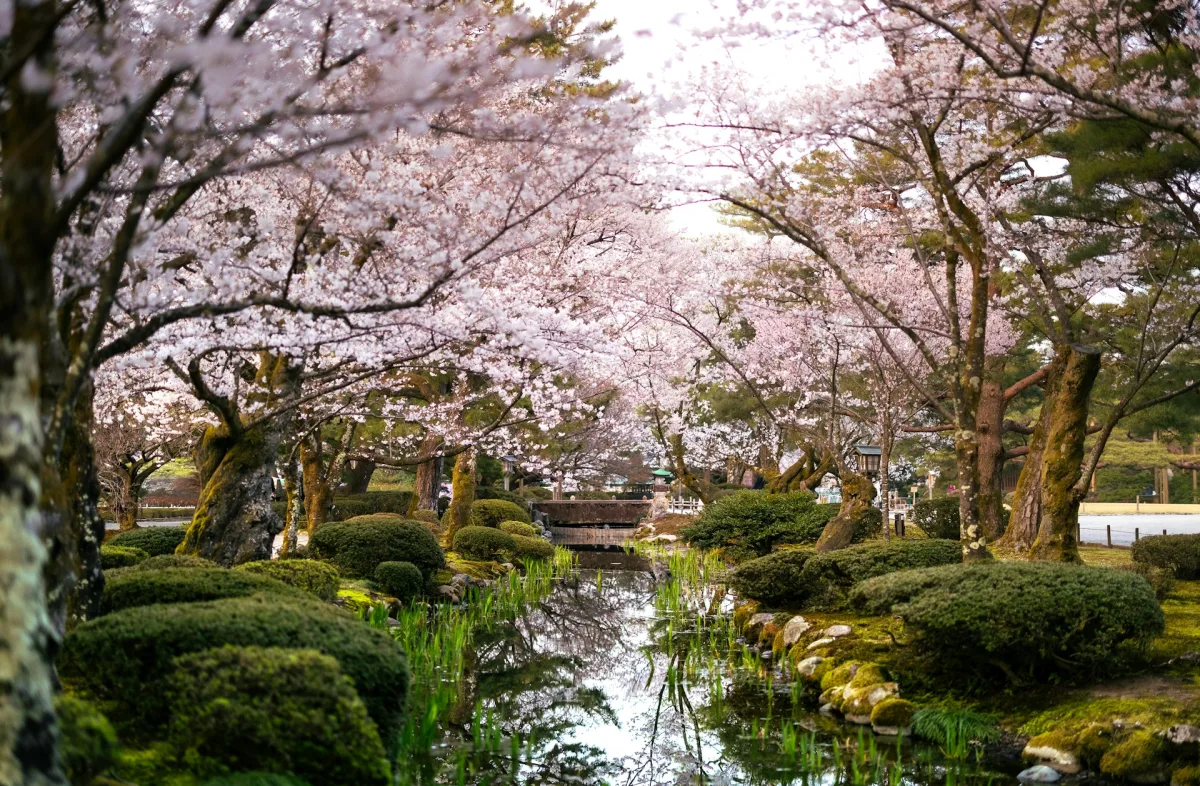
Kenroku-en is on every “Three Great Gardens of Japan” list for a reason. Twice-yearly, groundskeepers prop the snow-covered pine trees with wooden poles, creating a geometric pattern that’s become one of the iconic images of Japanese winter. In spring, the paths are lined with cherry blossoms. In summer, irises bloom around the pond.
The garden was built by the Maeda clan (the most powerful clan in feudal Japan outside the Tokugawa shogunate) and covers 11 hectares in the center of the city.
The one thing most visitors miss: arrive before 8am. The garden opens at 7am in warmer months. At 7:30am, you’ll have it largely to yourself. By 10am, tour buses have arrived.
Adjacent to Kenroku-en is Kanazawa Castle, partially reconstructed and free to walk around. The massive Hishi Yagura turret is open to climb inside — unusual for Japanese castles, most of which you can only view from outside.
Higashi Chaya: Where Geisha Culture Still Works
Higashi Chaya is the largest geisha district in the Chubu region. Unlike the famous districts in Kyoto (Gion, Pontocho), it’s not overrun.
The streets are short, clean rows of dark-latticed machiya buildings. Several are open as tea houses, museums, or shops selling gold-leaf products (Kanazawa produces 99% of Japan’s gold leaf). The Shima Ochaya tea house is a well-preserved example of an actual geisha establishment; you can tour the interior.
What’s different here from Kyoto: geisha are still regularly hired for private banquets in Higashi Chaya. This isn’t a museum industry. The women you might see at dusk walking between engagements are not actors or women hired for photo opportunities — they’re professionals, and the culture is intact.
Practical note: don’t follow, photograph without consent, or block their path. This is stated explicitly in the district signage. It’s also just basic human decency.
Nagamachi: The Samurai Quarter
Unlike Kyoto’s temple districts, Nagamachi was a residential neighborhood. The samurai who lived here weren’t the ruling elite; they were retainers of the Maeda clan — mid-ranking warriors with modest but refined homes behind high mud-and-plaster walls (dobei) along narrow lanes.
What makes it remarkable is that it’s still a residential neighborhood. Some buildings are preserved museums; others have people living in them. Walk the lanes and you pass both.
The Nomura Clan Samurai House is the most visited. It’s genuinely beautiful — a garden centered on a pond, with a first-floor room of lacquered furniture and a ceiling inlaid with artwork that survived three centuries. Entrance is ¥550 and worth every yen.
The 21st Century Museum: The Best Surprise in the City
The Kanazawa 21st Century Museum of Contemporary Art is architecturally extraordinary — a perfectly circular building with glass walls, designed by the same firm (SANAA) that designed the New Museum in New York and the Serpentine in London. You can see through the building from any direction.
The permanent collection includes “Swimming Pool,” an installation by Leandro Erlich in which visitors look down through a pool of water to see other visitors below, standing in what appears to be an underwater space. It’s been photographed millions of times; it’s even more surreal in person.
The rotating exhibitions are consistently excellent. Check what’s showing before you arrive — occasionally an exhibition is closed for rotation during the free-admission areas.
Cost: The courtyard and some areas are free. The full permanent collection costs around ¥2,000.
The Food: Why Kanazawa Belongs on Any Serious Dining Itinerary
Kanazawa is an under-discussed food city, which is remarkable given its reputation among Japanese people. The combination of access to the Sea of Japan’s cold-water seafood and centuries of refined cuisine developed under the Maeda clan created a distinct culinary tradition.
Omicho Market is the anchor. 180+ vendors across a covered market selling crabs, sea urchin, snow crab (zuwaigani), yellowtail (buri), and seasonal produce. January through March is crab season; the market becomes one of the most atmospheric places to eat in Japan.
Eat at the sushi counters inside the market — specifically the ones with no English menu in the window. They’re not trying to attract tourists. The fish is what arrived that morning.
Specialty to try: Kanazawa oden. Oden (simmered dishes in dashi broth) is common across Japan, but Kanazawa’s version includes local ingredients — crab claws, sea bass rolls, kartaage tofu — and the broth is distinctively clear and delicate. Oden restaurants are modest-looking places open for lunch and dinner; look for the red lantern.
Sake: the Noto and Kaga regions produce excellent sake. Fukumitsuya, one of Kanazawa’s oldest breweries, has a tasting room near Omicho market.
Where to Stay
The best choice is a ryokan. Kanazawa has several excellent options in the ¥15,000–30,000 per person range (including dinner and breakfast). This is not a splurge category for Japan; it’s standard ryokan pricing. Eating both meals at the ryokan makes logistical sense — dinner is kaiseki served in your room, breakfast is a small spread of local fish and pickles.
If you’re keeping costs down, business hotels near Kanazawa Station work fine. The city is small enough that you’re never more than 15 minutes by bus or taxi from any of the main areas.
Getting Around
Kanazawa has an excellent loop bus system (the Kanazawa Loop Bus) specifically for tourists, covering all the main districts. A one-day pass costs ¥600. Taxis are also inexpensive by Japan standards.
The three geisha and samurai districts are walkable from each other; Kenroku-en is in between. You could do all of it on foot if the weather is good.
A Note on Why to Go
Every tourist in Japan knows Kyoto. Most have heard of Nara. Kanazawa, despite being 2.5 hours from Tokyo and containing one of Japan’s great gardens, two of its best preserved historic districts, and some of its finest seasonal seafood, remains underexplored by foreign visitors.
That is almost certainly going to change. The new shinkansen extension has cut access times significantly. Travel media is beginning to notice.
Go now, before the tour operators fully arrive. Two days in Kanazawa is, for many travelers, the part of the Japan trip they talk about the most afterward.
Plan your trip