Busan: Korea's Coastal City in Full
Plan your trip
Busan’s geography defines it: mountains come directly down to the sea, leaving narrow valleys where the city built its neighborhoods between the ridgelines. The port sits in a natural harbor; the beaches are to the east; the fish market is in the center; and the hillside villages — built by refugees during the Korean War, who climbed the slopes because no flat land was available — are the visual signature of a city that improvised its way through the 20th century.
The result is a city with more visual variety per square kilometer than Seoul — because the topography forced variety. You take a subway two stops and arrive at a completely different urban character. The beaches, the port, the markets, and the mountain parks coexist in a city that takes less than 2.5 hours to reach from Seoul by KTX.
Getting There
From Seoul Station: KTX to Busan Station (2 hours 15 minutes, ₩59,800 standard; ₩41,500 early booking discount). The fastest and most convenient option. JR Pass equivalent does not apply; buy KTX tickets at Letskorail or KoreaTrain apps.
From Incheon Airport: Direct bus to Busan (4–5 hours, ₩43,000) or flight (1 hour, ₩40,000–90,000). The bus is the budget option; the train via Seoul adds 3+ hours.
Within Busan: The Busan Metro covers all major tourist areas — Haeundae (Line 2), Jagalchi/Nampo (Line 1), Gamcheon (Line 1 + bus), Gwangalli (Line 2), Taejongdae (Line 1 + bus). A 1-day pass (₩4,800) covers most needs.
Gamcheon Culture Village
Busan’s most photographed neighborhood: the hillside village of Gamcheon-dong, where the houses of Korean War refugees were painted in bright blues, yellows, and pinks in a 2009 art renewal project. The result is a labyrinth of narrow stairs and lanes on a steep hillside, with murals, small galleries, craft shops, and the specific view of the harbor below and the city spreading around the bay.
The Little Prince Trail: The most popular walk through the village, marked by stamps and sculptures referencing Antoine de Saint-Exupéry’s story. The trail’s official start is at the visitor center near the main entrance; the stamps collected at waypoints are the basis for postcards at the information center.
What Gamcheon actually is: A working neighborhood. Not all residents are enthusiastic about the tourism that came with the art project; the narrow lanes were housing, not photo backdrops. The village is at its most authentic early morning (before 9am) when residents are out and tourist groups have not arrived.
Getting there: Bus 1-2 or 2 from Toseong-dong Station (Busan Metro Line 1). The climb from the bus stop to the village entrance takes 10–15 minutes.
Jagalchi Fish Market
Korea’s largest fish market — a two-story covered market building and the surrounding outdoor stalls on the Nampo-dong waterfront. The market operates from predawn (the wholesale area activating from 4–5am) through the evening, when the second-floor restaurants serve the morning’s catch.
The wholesale section (early morning): Hundreds of stalls of live fish, shellfish, sea vegetables, and dried seafood. The Korean buyers selecting for the day’s restaurant menus; the haenyeo-style ajumma vendors in rubber boots and yellow rubber aprons. This is the most active and atmospheric time.
The restaurant floor: The second floor of the main building has dozens of restaurants where you select your fish from the tanks below and have it prepared upstairs. The process: choose a live fish or seafood from the display, negotiate the price per geun (600g), and it is cleaned, filleted, and served as hoe (raw sashimi-style slices) with gochujang, sesame oil, vegetable wraps, and the standard cha accompaniments. A full hoe meal for two: ₩30,000–60,000 depending on the fish.
What to eat: Gwang-eo (halibut) is the quality reference for white fish hoe; nakji (octopus), ganjang gejang (raw crab in soy) and haemultang (seafood stew) are the marine preparations the market does best.
Haeundae Beach
Korea’s most famous beach — 1.5 km of white sand on the eastern coast of Busan, backed by the Haeundae hotel district (Westin, Paradise, Novotel, and the distinctive Marine City apartment towers in the background).
The beach: In summer (July–August) the beach reaches 1 million visitors on peak days. The density is extraordinary — essentially wall-to-wall umbrellas and beach chairs. This is the Korean summer beach culture at maximum expression.
Off-season Haeundae: October–June, the beach is nearly empty, the water too cold for swimming, but the promenade is pleasant and the cafés and restaurants face an empty beach. Far more walkable in the shoulder seasons.
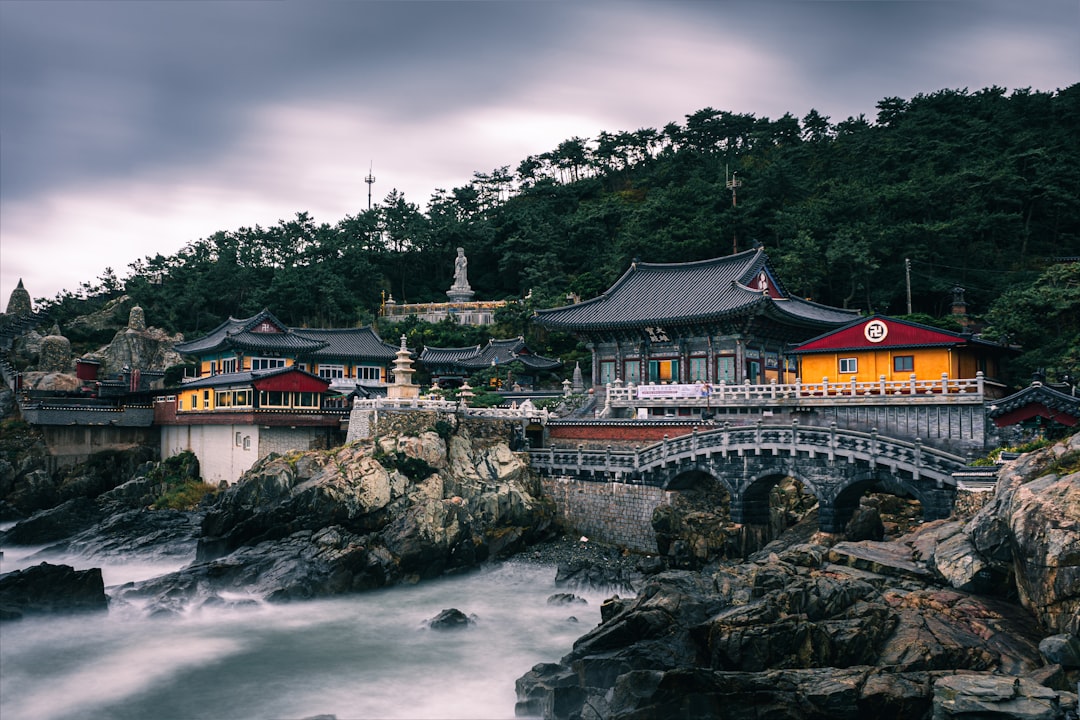
Haedong Yonggungsa: 15 minutes from Haeundae by bus — the only major sea-cliff Buddhist temple in Korea, built directly on the rocky coastline with the Sea of Japan waves at its base. The temple complex (rebuilt in 1970s on a 1376 foundation) has dramatic rock formations, a lighthouse, and the specific atmosphere of sacred space on a coastal cliff. Early morning or late afternoon for minimum crowds. Free entry.
Gwangalli Beach and the Diamond Bridge
2 km from Haeundae: the beach neighborhood with the best view of the Gwangan Bridge (the “Diamond Bridge”) — the 7.4-km suspension bridge connecting two parts of Busan over the bay. The beach is shorter than Haeundae and the surrounding neighborhood is more developed with cafés and restaurants. The bridge is illuminated at night; the café district facing the illuminated bridge is the best evening view in Busan.
The fireworks festival: The Busan International Fireworks Festival (October/November) launches from the Gwangalli waterfront — two nights of international competing teams, viewed from the beach or the cafés above. One of the best fireworks festivals in Korea.
Taejongdae
The sea cliff park on the southwestern tip of the Yeongdo peninsula — volcanic cliffs dropping directly into the sea, lighthouse views, and the best panoramic coastline scenery in Busan. The park is accessed by a walking trail or the Taejongdae Danubi Train (a small tourist tram that loops through the park).
The lighthouse viewpoint: The highest point of the park, with 360-degree views of the sea and the Busan harbor approaches. The rocky cliffs below attract anglers; the sea in clear weather shows the island chain toward Japan.
Sunrise/sunset: Taejongdae faces west-southwest; sunset from the viewpoints is excellent.
Busan’s Street Food and Markets
Gukje Market (International Market): The large traditional market near Nampo-dong, operating since the Korean War when refugees established informal trade. Multiple covered sections: clothing, household goods, foreign goods (the “international” in the name), and food. The bungeo-ppang (carp-shaped pastry filled with sweet red bean or custard) vendors operate in the market; the tteokbokki and sundae (rice cake sausage) stalls are in the inner lanes.
Bupyeong Kkangtong Market: The night market that operates in Bupyeong-dong from 7pm. The arched shopping arcade fills with street food vendors — dak-kkochi (chicken skewers), pa-jeon (green onion pancake), grilled meat, and Korean-Chinese fusion dishes. Local Busan crowd, not tourist-focused.
BIFF Square (Busan International Film Festival Square): The film walk in Nampo-dong with celebrity handprints in the pavement — the main outdoor venue of the Busan International Film Festival (October). The surrounding streets have Busan’s best concentration of ssiat-hotteok vendors (the Busan version of hotteok filled with cinnamon sugar and sunflower seeds, pressed to a crispy exterior).
Busan Cinema and the BIFF
The Busan International Film Festival (BIFF, October) is Asia’s largest and most prestigious film festival — the primary Asian platform for international premieres and Korean cinema. The festival uses multiple venues across Busan; the central venue cluster is in Haeundae (the BIFF Village on Centum City) and the historical BIFF Square in Nampo-dong.
For visitors who arrive in October, the BIFF atmosphere — outdoor screenings, director Q&As in outdoor tents, the celebrity presence in Haeundae hotels — is a significant cultural event.
Multi-Day Structure
2 nights: Day 1 — Jagalchi Market (morning), Gamcheon (afternoon), Nampo-dong/BIFF Square (evening), Bupyeong night market. Day 2 — Haedong Yonggungsa (early morning), Haeundae Beach, Gwangalli evening.
3 nights adds: Taejongdae, Gukje Market, day trip to Gyeongju.
Busan is the argument against spending an entire Korea trip in Seoul. The seafood is different (fresher, more available, the market culture more visible), the geography is different (hills, sea, actual beaches), and the specific Busan character — coastal, direct, shaped by the war refugee population that built it — produces a city that has nothing of Seoul’s self-consciousness and everything of a port city’s pragmatic openness.
Plan your trip