Busan Travel Guide: 3 Days in South Korea's Coolest City
Plan your trip
Most travelers put Busan at the end of their Korea itinerary, as a two-night stop before flying home. That’s one way to do it. The better way is to treat it as a separate destination — a city with its own character, its own food culture, and a coastline that makes Seoul feel very far away.
Busan is a port city. It’s louder than Seoul, more salt-weathered, somehow more casual. The pace changes as soon as you step off the KTX. The streets are steeper. The neighborhoods climb hills above harbor views. The fish was alive this morning.
Three days is enough to feel it properly.
Getting to Busan
KTX from Seoul: 2 hours 40 minutes from Seoul Station to Busan Station. Trains run every 30–60 minutes throughout the day. Standard fare: ₩59,800 one-way ($44). Book in advance on the Korail app or at the station — weekend trains fill up fast.
By plane: Gimhae International Airport (PUS) has direct flights from Japan, China, Taiwan, and Southeast Asia. From inside Korea, the KTX is more convenient and usually cheaper than flying from Seoul.
Busan Station itself is in the Jungang-gu/Choryang area — somewhat central but not particularly interesting. Most travelers head immediately to their neighborhood by metro (the Busan Metro is excellent, ₩1,400–2,000 per ride).
Where to Stay
Haeundae: Busan’s most famous beach neighborhood. Expensive hotels, international tourists, loud. Good if you want beach access; less good for experiencing the real city.
Gwangalli: The better beach. More local atmosphere, good bar/restaurant strip along the esplanade, views of Gwangan Bridge. Mid-range hotels at lower prices than Haeundae.
Nampo-dong/Jung-gu: Central, close to Jagalchi Market and the ferry terminals, walkable to old Busan. Most convenient base for three days.
Recommendation: Stay in Gwangalli or Nampo-dong. You’ll spend less and have better access to the city’s actual character.
Day 1: Gamcheon, Jagalchi, Gwangalli
Morning: Gamcheon Culture Village
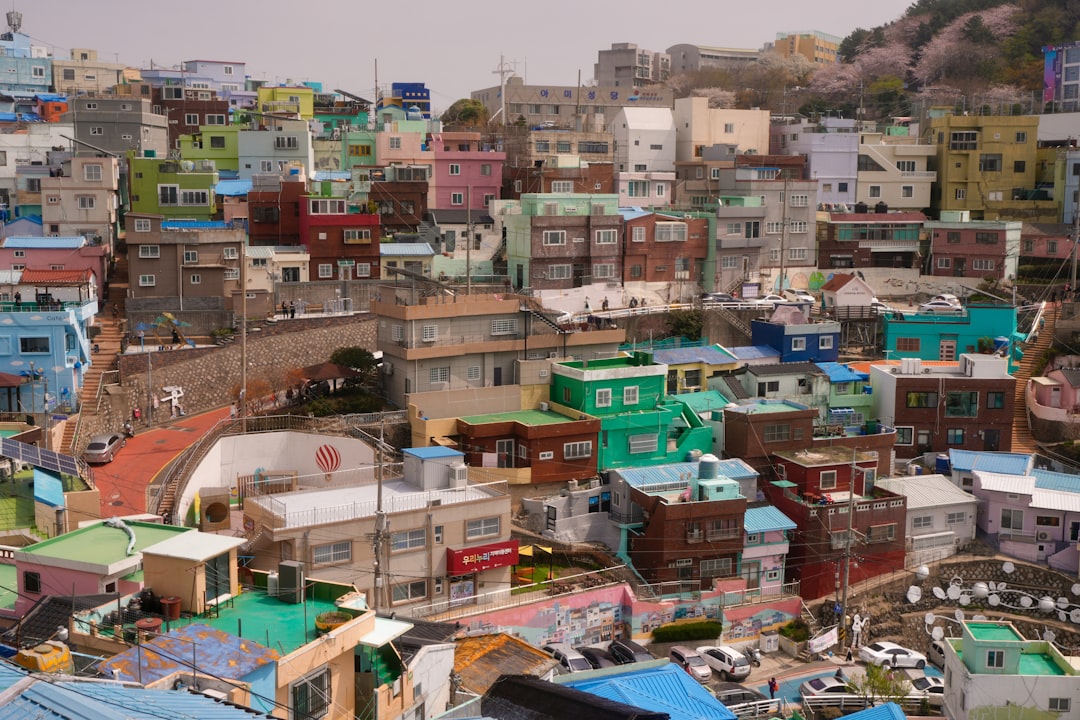
Gamcheon (감천문화마을) is frequently described as “Busan’s Santorini.” That comparison both oversells and undersells it.
What it actually is: a dense hillside neighborhood built by refugees from the Korean War who had nowhere else to go. The houses were packed close, stacked up the slope, painted in whatever colors were available. Poverty created the aesthetic accidentally. Over decades, the neighborhood aged and thinned out. Then, starting around 2009, local artists began a project to revitalize it — murals appeared, small galleries opened, the colorful staircases were restored.
The result is one of the most photographed neighborhoods in Korea. The view from the top of the hill, looking down over the terraced pastel houses to the harbor, is extraordinary.
What people get wrong about Gamcheon: They arrive at 11am on a weekend and spend 45 minutes in the main tourist square, buy a fish-shaped bread, and leave. That’s the Instagram version.
Do this instead: arrive before 9am. Walk past the tourist square. The residential streets above and beyond it are just as colorful and almost empty. The real neighborhood — where people actually live — is accessed by going uphill past where the designated “art village trail” ends. The views get better. The crowds disappear.
Getting there: Bus 1 or 2 from Toseong-dong Station (Line 1), get off at Gamcheon Culture Village stop. Or taxi from anywhere in Nampo-dong (~₩6,000–8,000).
Afternoon: Jagalchi Fish Market
Korea’s largest seafood market, on the waterfront in Jung-gu. The covered building has two floors: ground floor vendors sell live and fresh seafood from tanks and ice; upper floor restaurants will prepare whatever you bring them, or serve from their own menu.
Walk the ground floor slowly. Watch the vendors argue with suppliers, weigh crabs, spray tanks. The volume and variety is overwhelming — sea urchin, abalone, live octopus, various clams, enormous crabs.
For lunch: take the escalator to the upper floor and sit at one of the counters. Point at what you want. The most interesting order here is hoe (회) — Korean-style sashimi, served with gochujang, sesame oil, and perilla leaves for wrapping (different from Japanese sashimi; the condiments change the experience entirely).
If you have budget: get the haemul pajeon (seafood pancake) and a bottle of soju from the vendor stalls just outside the main building. Eat on the steps by the water.
Getting there: Jagalchi Station (Line 1), Exit 10.
Evening: Gwangalli Beach and the Bridge
Walk the Gwangalli (광안리) esplanade at sunset. The beach isn’t remarkable in itself — it’s an urban beach — but the Gwangan Bridge (다이아몬드 브리지) lights up at night and the combination of bridge, sea, and city creates one of Busan’s signature views.
The restaurants and bars along the esplanade range from grilled fish places to cocktail bars. Eat somewhere with an outdoor table facing the bridge. After dark, the beach fills up with groups drinking and playing music — informal, cheerful, very local.
Day 2: Haedong Yonggungsa, Haeundae, Beomeosa
Early Morning: Haedong Yonggungsa Temple
Built in 1376, destroyed during the Japanese occupation, reconstructed in 1930. Located on a rocky clifftop where the East Sea crashes against the foundations.
Most Korean temples are set in forests on mountainsides. Haedong Yonggungsa is, deliberately and dramatically, set above the sea. The approach — down stone staircases with carved stone zodiac animals — ends at a plaza where the main hall sits directly above the water. Waves break beneath it. Salt spray hits the walls.
Go at sunrise. This requires getting up very early (Busan sunrise in October is around 6:40am; in April, 6:10am). The temple and coastal path are empty. The light on the sea is soft. The main hall incense smoke drifts toward water. It is one of the better things you will see on a trip to Korea.
Getting there: Bus 181 from Haeundae Station, get off at Haedong Yonggungsa. About 25 minutes from Haeundae.
Late Morning: Haeundae Beach and Market
Korea’s most famous beach. In summer it fits 100,000 people on the sand. In spring and autumn, it’s manageable.
Skip the beach (unless summer); instead, walk the Haeundae Traditional Market behind the beach. This is where locals shop — fresher, cheaper, more interesting than the beachfront. The jajangmyeon (black bean noodles) and sundubu jjigae stalls are worth the detour.
Dongbaekseom Island: A small forested promontory attached to the east end of Haeundae beach by a causeway. Walking path around the island takes 30 minutes. Good views back over the beach and toward Gwangalli.
Afternoon: Beomeosa Temple
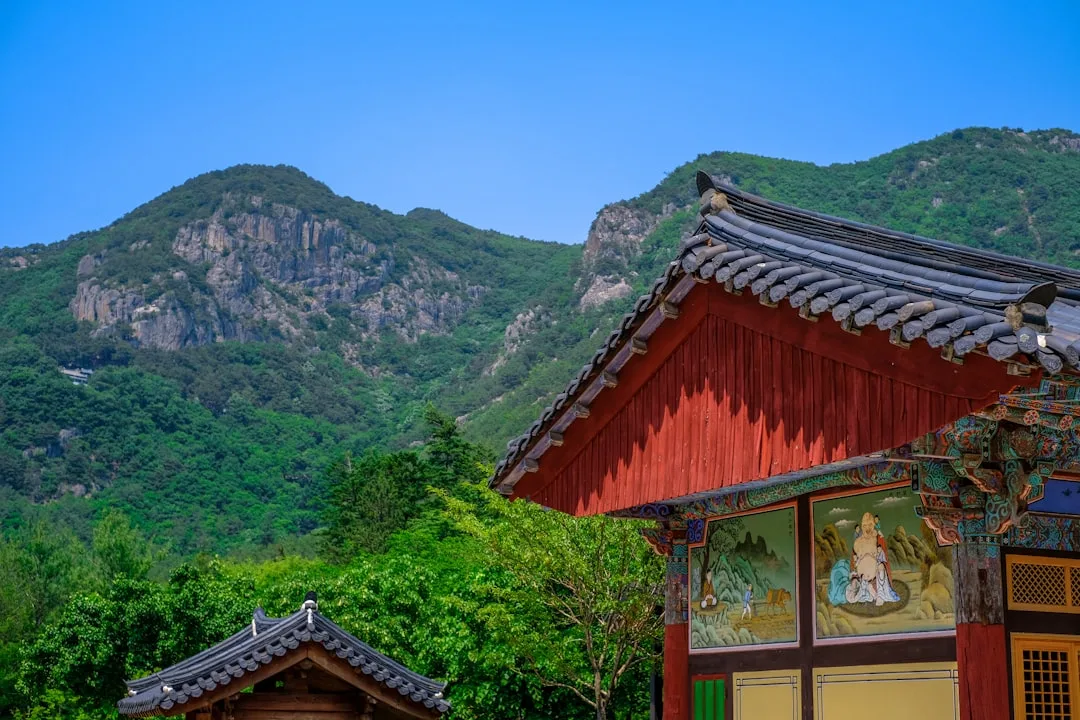
In the mountains north of Busan, 30 minutes from Haeundae. One of the most important Buddhist temples in Korea, founded in 678 CE. Set at the end of a forested valley, reachable by a path that climbs gently through pine trees.
Unlike the coastal drama of Haedong Yonggungsa, Beomeosa is contemplative — wide stone courtyards, ancient wooden halls, monks moving between buildings. The Iljumun gate at the entrance is a formal threshold: you’re crossing from ordinary space into sacred space.
If you’re there on a Saturday, the public yebul (evening prayer service) at 6pm is open to visitors. The combination of chanting, drumming, and incense in the main hall is worth being present for.
Getting there: Metro to Beomeosa Station (Line 1), Exit 5. Then Bus 90 or a 10-minute taxi. The bus stops at the lower temple carpark; from there it’s a 20-minute walk uphill.
Day 3: Taejongdae + Afternoon at your pace
Taejongdae Provincial Park
On the southern tip of Yeongdo Island, connected to central Busan by bridge. A forested coastal park with walking trails and cliffs above the sea.
The Yeong-do Cliff viewpoint shows the Korea Strait stretching south toward Japan. On a clear day, you can see the outline of Tsushima Island. The trails through the park take 2–3 hours at a reasonable pace.
The Taejongdae Lighthouse is worth the walk — a working lighthouse from 1906, surrounded by pines and accessible by footpath. There’s also a small train (the Danubi tourist train) that loops through the park if you’d rather ride.
Getting there: Bus 8, 30, or 88 from Nampo-dong to the Taejongdae stop.
Afternoon: BIFF Square and Food
BIFF Square (부산국제영화제 광장) in Nampodong — the Busan International Film Festival plaza, with handprints of Korean actors and directors embedded in the pavement, surrounded by snack stalls, street food vendors, and old cinema buildings.
The food here: ssal hotteok (rice cake hotteok filled with seeds and brown sugar), odeng (fish cake on sticks from a cart), and dwaeji gukbap (pork rice soup) from one of the old-school restaurants facing the plaza.
Dwaeji Gukbap — a Busan specialty. Pork bone broth soup with rice added directly to the broth. Simpler than it sounds; the depth comes from hours of simmering. The Nampodong area has restaurants that have been serving it since the 1950s. Look for a place with no English sign and plastic stools.
Practical Notes
Weather: Busan is slightly warmer than Seoul year-round. October is the best month — cool, dry, clear. August is hot and humid. January–February can be cold and grey.
Food: Busan is known for dwaeji gukbap (pork rice soup), milmyeon (wheat noodles in cold broth), and the freshest seafood in Korea. If you’re a serious eater, allocate one meal per day specifically to something you’ve never tried.
Getting around: The metro covers the major sites. Taxis are inexpensive (base fare ₩4,800) and drivers are generally helpful with a destination written in Korean on your phone.
Combining with Gyeongju: Busan to Gyeongju is 18 minutes by KTX (Singyeongju Station) or about 1 hour by bus. If your itinerary includes Gyeongju, doing Busan then Gyeongju then Seoul (or vice versa) is more efficient than doubling back.
Busan rewards wandering. The best parts of the city aren’t on the official tourist map — they’re on the slopes above Gamcheon, in the market halls behind Jagalchi, on the coastal path past Haedong at 6am when the light comes sideways off the sea.
Plan the framework. Let the city fill in the rest.
Plan your trip