Serengeti Great Migration: Month-by-Month Guide
Plan your trip
The Great Migration is the largest terrestrial mammal movement on Earth — approximately 1.5 million wildebeest, 200,000 zebra, and 400,000 Thomson’s gazelle moving in a roughly clockwise circuit through the Serengeti-Mara ecosystem across Tanzania and Kenya. The circuit is driven by rainfall and grass availability; the animals follow the grass, and the grass follows the rain.
The movement is continuous — there’s no single “Migration moment.” What varies month by month is the density of animals in specific areas, the availability of dramatic events (calving, river crossings, predator activity), and the accessibility of the best viewing locations.
The Annual Cycle
January–February: Calving Season (Southern Serengeti)
Location: Ndutu area, Southern Serengeti, the Ngorongoro Conservation Area plains
The short dry spell of January–February concentrates the herd in the southern Serengeti and the Ndutu region, where the short-grass plains support the nutritional requirements of calving. In January–February, approximately 500,000 wildebeest calves are born within a 3-week period — the greatest single birth event of any mammal population on Earth.
The calving strategy: Wildebeest synchronize births to overwhelm predators — predator populations cannot consume 500,000 calves in 3 weeks, so the majority survive despite significant predation. The result is an explosion of predator activity (lions, cheetahs, hyenas, wild dogs) that is arguably the most dramatic wildlife event in the Serengeti calendar.
What to see: Newborns (calves stand within minutes of birth), predator hunts at extraordinary frequency (cheetahs in the open short-grass plains are particularly visible), and the sheer density of animals on the Ndutu plains.
Best camps: Ndutu Safari Lodge, Ndutu Tented Camp, and the mobile camps in the Ngorongoro-Serengeti border area.
March–April: Rains Arrive (Southern and Central Serengeti)
The long rains begin in March. The herds remain in the south and begin moving north through the central Serengeti (Seronera) as the northern grass becomes available. Predator activity continues to be high. The landscape turns green.
Viewing consideration: Rain makes tracks difficult; some camps become less accessible. Prices drop significantly. The predator activity and green landscape are excellent compensations for occasional rain.
May–June: Transition (Western Corridor)
The herd moves northwest through the Grumeti corridor — the western approach to the Mara River system. The Grumeti River, smaller and less famous than the Mara, has its own crossing events as the herd moves through the western corridor.
Grumeti River crossings: Less dramatic than the Mara crossings (fewer crocodiles, lower banks) but genuine river crossing events occur. The western corridor camps (Serengeti Grumeti River Lodge, Mobile Grumeti camps) position visitors for this.
July–September: Mara River Crossings (Northern Serengeti)
Location: The Lamai Triangle and Kogatende area (Tanzania), the Masai Mara (Kenya)
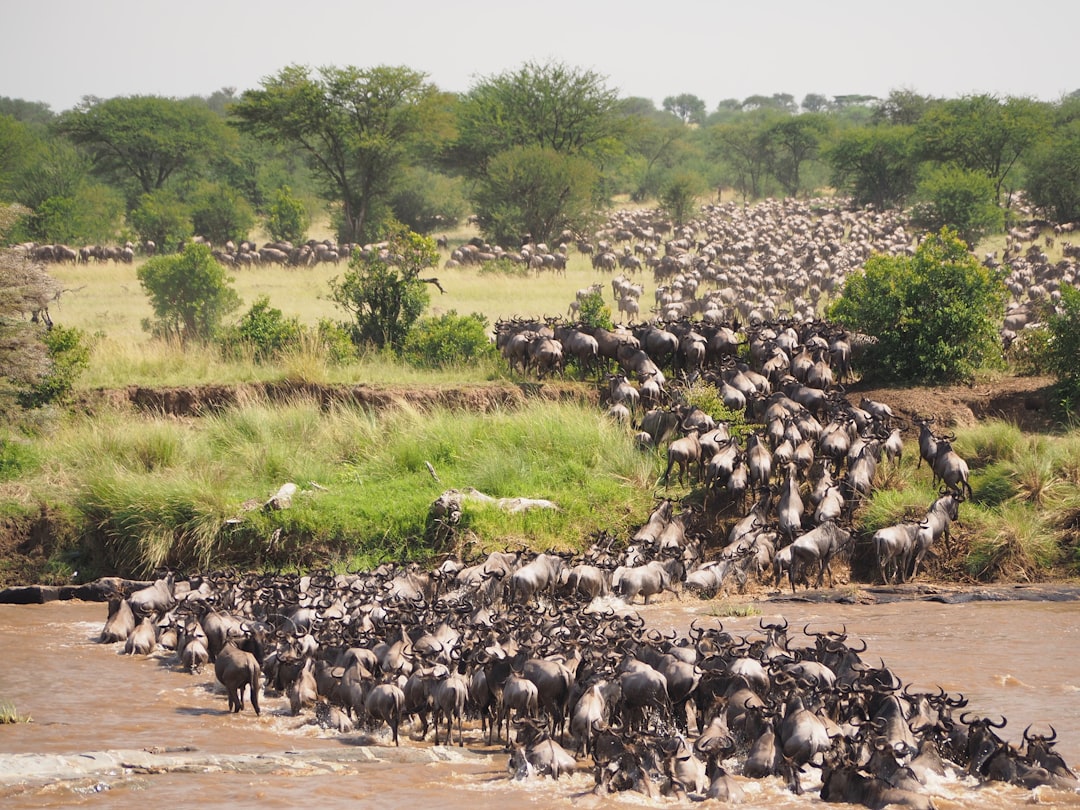
The most spectacular phase — the herd has moved to the northern Serengeti and the Kenya border, and must cross the Mara River to reach the Kenya grasslands. The Mara River is infested with Nile crocodiles (up to 4 meters); the crossings involve thousands of wildebeest descending the river banks in mass panic, swimming through crocodile-infested water, and scrambling up the far bank.
Why it’s extraordinary: The crossings are not single events — the herd crosses and re-crosses the same points over weeks, with crossings happening several times a week at peak season. A crossing lasts 20 minutes to 2 hours; the drama is extreme (stampedes, crocodile attacks, animals drowning, successful crossings).
What determines when a crossing happens: The herd’s behavior is not predictable to the hour. Animals will approach the bank, panic, and retreat repeatedly before committing to a crossing. Patience and time at the crossing points is the determining factor for witnessing one.
Best positioning: The Kogatende area on the Tanzanian side of the Mara River is the prime location. The major crossing points are the Crossing Point 7 (Mara crossing near Kogatende) and the Sand River crossing. Mobile camps in the Lamai Triangle are positioned for multiple crossing point coverage.
Camps: Serengeti Migration Camp (Kogatende), Lemala Kuria Hills, various mobile camps in the Lamai Triangle area.
Timing: July is when the herd arrives; August–September is peak crossing activity; October the herd is often in Kenya with only partial presence on the Tanzanian side.
October: Return South (Northern Serengeti)
The short rains in Kenya push the herd back south across the Mara River. October crossings occur in the opposite direction. Less visited than August–September but genuine crossing events.
November–December: Moving South (Central and Southern Serengeti)
The herd disperses south across the central Serengeti toward the calving grounds again. Heavy rains make some tracks difficult; grass is long; the herd is spread widely across the ecosystem rather than concentrated.
Positioning for Maximum Impact
The Two Peak Experiences
Option 1 — Calving Season (January–February): Best for cheetah sightings, newborn animals, and predator density. Less dramatic visually than river crossings, but the ecological event (birth, predation, survival) is more complete.
Option 2 — Mara River Crossings (July–September): The television migration moment. Requires positioning in the northern Serengeti (Kogatende/Lamai Triangle). August is the safest time statistically to witness a crossing.
Misconceptions
“The migration is everywhere in July”: The herd concentrates in the northern quarter of the Serengeti and Kenya in July–September. The central Serengeti (Seronera) is largely empty of the main herd at this time. Staying near Seronera and expecting crossing sightings doesn’t work.
“River crossings happen on a schedule”: They don’t. A guide watching the behavior of the herd at the riverbank can often predict that a crossing is imminent (the herd bunches, moves toward the bank repeatedly), but specific timing is impossible. The crossing can happen 30 minutes after arrival or after 6 hours of watching.
“You must be in Kenya to see crossings”: The Lamai Triangle on the Tanzanian side of the Mara River has equivalent crossing access to the Kenyan side. No Kenya visa required; Tanzania entry only.
Practical Decisions
Safari length: The Great Migration requires at least 3 nights in the appropriate area at the right time of year. A single-day visit to the Serengeti from Arusha cannot position you for either calving or crossing events at sufficient depth.
Budget: Premium migration camps (particularly the Lamai Triangle mobile camps) are the most expensive in Tanzania’s safari market. A 3-night stay at a leading migration camp costs $1,500–3,000/person. More affordable options (private budget camping, less precisely positioned camps) see the Serengeti but have lower crossing probability.
Flexibility: If river crossing viewing is the specific goal, budget 5–7 nights in the northern Serengeti in August to cover statistically multiple opportunities. Shorter stays at the correct time (August) are better than longer stays at the wrong positioning.
Plan your trip