Nijō Castle: The Shogun's Kyoto Palace
Plan your trip
Nijō Castle was built in 1603 on the orders of Tokugawa Ieyasu, the newly unified ruler of Japan, as his official Kyoto residence — the seat of shogunal authority in the imperial capital. It served the Tokugawa shogunate for 265 years, until 1867 when the last shogun, Yoshinobu, formally announced the restoration of imperial rule from within its walls. It is one of the few places in Japan where you can stand in the room where a historical era ended.
The complex was designated a UNESCO World Heritage Site in 1994 as part of the Historic Monuments of Ancient Kyoto.
What’s Here
The castle compound consists of two concentric ring fortifications (the Ninomaru inner compound and Honmaru outer compound), a palace, gardens, and watchtowers. Most visitors spend their time in the Ninomaru Palace and the Ninomaru Garden.
Ninomaru Palace
The palace is the centerpiece — a connected series of six buildings covering approximately 3,000 square meters, arranged in a zigzag formation that served both aesthetic and security purposes. The palace is divided into reception halls of increasing intimacy: the outer rooms for general audiences, the middle rooms for meetings with feudal lords, and the inner rooms — furthest from public view — as the shogun’s private quarters.
The painted interiors are exceptional examples of the Kanō school of Japanese painting. Every surface — sliding screens, wall panels, transom — is covered with tigers in bamboo groves, eagles on pine branches, and flowering trees. The paintings are simultaneously decorative and political: they announce the shogun’s power through the authority of the natural world represented in gold.
The nightingale floors (uguisubari): The corridors of the Ninomaru Palace are fitted with a floor system designed to squeak under foot pressure — a security measure against silent approach. The sound is produced by clamps beneath the floorboards that rub against nails as weight shifts. The name uguisubari (bush warbler floorboards) comes from the resemblance to birdsong. The floors still work; you can hear them throughout the palace.
Shoes are removed at the entrance; the palace is experienced in sock feet on the centuries-old wooden floors.
Ninomaru Garden
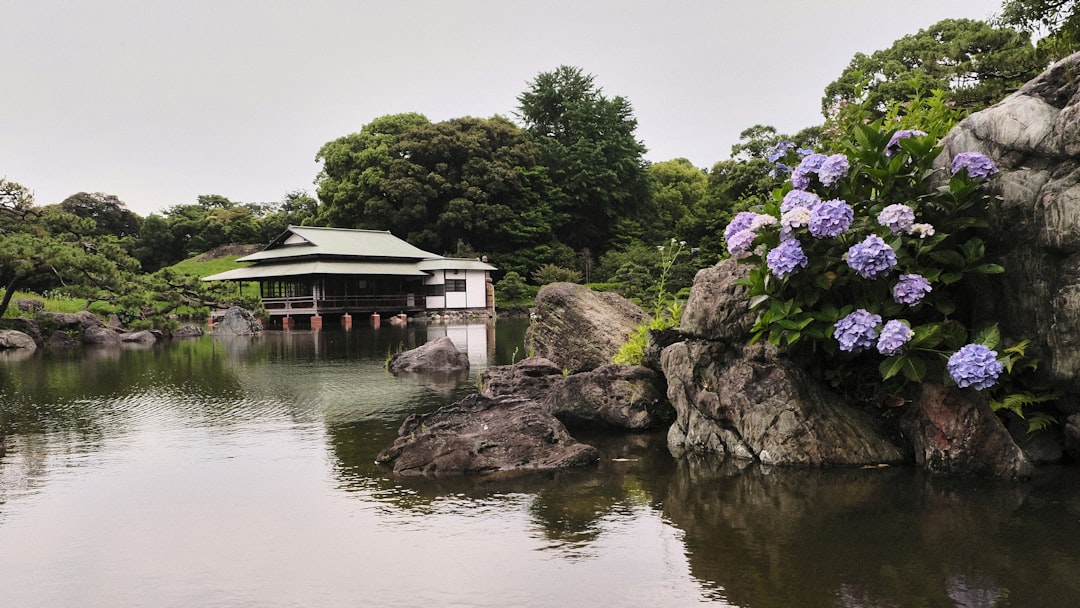
The garden surrounding the Ninomaru Palace was designed by the tea master and garden designer Kobori Enshū, one of the defining aesthetic figures of the early Edo period. The design follows the traditional chisen-kaiyu-shiki (strolling garden with pond) format — meant to be experienced by walking around the central pond rather than viewed from a fixed point.
Three islands in the pond, connected by stone bridges and stepping stones, represent the Taoist paradise islands of Hōrai, Kamejima (turtle), and Tsurujima (crane) — symbols of longevity standard in Japanese garden symbolism of the period. The composition is considered one of the finest surviving examples of early Edo garden design.
In cherry blossom season (late March–early April), the garden is exceptional, though crowds are proportionally heavy.
Honmaru Palace
The original Honmaru Palace burned in 1750 and was replaced in 1893 with structures relocated from the imperial palace. It is open to visitors on a more limited basis than Ninomaru, and the experience is less rich than the older palace.
Watchtowers and Walls
The stone walls and moat give the compound its castle character. The walls are built in nozurazumi style (natural stone without cutting), which is specific to castles of the early Edo period. The southeast watchtower (Tatsumi Yagura) survives from the original construction and provides context for the defensive purpose of a compound that was, architecturally, also trying to announce cultural refinement.
The Historical Moment
In November 1867, Shogun Tokugawa Yoshinobu summoned 40 feudal lords to the Ninomaru Palace’s grand audience hall — the same room where the Tokugawa shoguns had received obeisance for two and a half centuries — and announced the end of the Tokugawa shogunate. He returned political authority to Emperor Meiji, ending the Edo period without a battle in this hall.
The room exists. You walk through it. The event is explained on the interpretive panels. It is one of the stranger moments of historical proximity available in Japan: the room where a 265-year dynasty formally ended, preserved intact.
Visiting
Address: 541 Nijōjō-chō, Nakagyō-ku, Kyoto
Hours: 8:45am–5:00pm (last entry 4:00pm); closed Tuesdays in January, July, August, December
Admission: ¥1,300 adults (includes Ninomaru Palace); additional ¥700 for Honmaru Palace when open
Access: Subway Tōzai Line to Nijōjō-mae Station (Exit 1), 1-minute walk. City bus to Nijōjō-mae stop.
Time required: 1.5–2 hours for the full compound including garden circuit. The palace walk is entirely indoor (useful on rainy days); the garden circuit is outdoor.
Photography: No photography inside the Ninomaru Palace buildings. Photography permitted in the gardens and exterior areas.
When to Go
Cherry blossom season (late March–early April): The castle grounds have over 400 cherry trees, and the event is celebrated with evening illuminations. Beautiful and crowded.
Autumn foliage (mid-November): The Ninomaru Garden in autumn colors is among the quieter of Kyoto’s autumn experiences — it doesn’t attract the same crowds as Tofuku-ji or Arashiyama.
Weekday mornings: The castle opens at 8:45am and is quiet before the tour groups arrive at 10am. Going at opening is one of the most effective strategies for experiencing the Ninomaru Palace without compression.
In Context with Other Kyoto Castles and Palaces
Nijō fits into Kyoto’s historical landscape alongside the Kyoto Imperial Palace (which can be visited — the palace grounds are open free; the palace interior requires advance reservation) and Fushimi Momoyama Castle (Toyotomi Hideyoshi’s earlier power statement, mostly a reconstruction). Nijō is the only surviving intact example of a Tokugawa-era shogunal residence in Japan.
The castle is about 15 minutes by bicycle from Kinkaku-ji to the northwest, and 20 minutes from Gion to the east. It fits naturally into a day combining western Kyoto temples with a central city stop.
Plan your trip