Onsen in Japan: How They Work and Where to Go
Plan your trip
Japan has more than 27,000 natural hot spring sources, more than any other country. There are around 3,000 onsen-chi (hot spring towns) distributed across the country, concentrated wherever volcanic activity meets the surface. The bathing culture built around these springs — nyūyoku bunka — is not a spa tourism phenomenon. It is a daily practice for many Japanese people, a medical tradition recognized by the government, and a form of architecture, landscape design, and social ritual that has been developing for over a thousand years.
Going to an onsen is not complicated. But the etiquette around it is specific, and understanding it in advance makes the experience much better.
How Onsen Work
An onsen is technically any bath fed by natural hot spring water meeting specific mineral and temperature criteria (the Water Law of 1948 defines the thresholds). The distinction from regular public baths (sentō) matters: sentō uses heated tap water; onsen uses natural spring water with specific mineral properties that are considered therapeutically distinct.
Most onsen in Japan are gender-segregated: men and women bathe separately in different bath areas. Mixed bathing (konyoku) exists but is increasingly rare and usually involves a rotemburo (outdoor bath) in more remote ryokan. Bathing suits are not worn in traditional onsen.
The mineral composition varies significantly between springs, and different compositions are traditionally associated with different health benefits: sulfuric water for skin conditions, iron-rich water for anemia, alkaline water for general skin health. Whether the therapeutic claims are clinically valid is debated; the mineral differences are real.
Etiquette: What You Actually Need to Know
Wash first, bathe second. This is the fundamental rule. Each onsen bath area has a row of shower stations (with stool, handheld shower, shampoo, and body wash). You sit at a station, wash your entire body, and rinse completely before entering the communal bath. This is not optional or flexible.
No towel in the bath. The small towel provided (usually included or rented) is for drying and for personal modesty while walking between the showers and bath. It does not go in the water. Some people fold it on their head; most just set it aside.
No swimsuits (in traditional onsen). You bathe without clothing in traditional onsen. This is the rule that surprises first-time visitors most. It normalizes quickly.
Tattoos: Traditional Japanese onsen policy prohibits tattooed guests, rooted in historical association between tattoos and organized crime. This is the most practically relevant issue for international visitors. Enforcement varies: large resort ryokan tend to be strict; smaller rural baths are often relaxed or simply unstated. Increasingly, onsen are creating private bath options (kashikiri) that accommodate guests with tattoos. Always check policy before booking.
Be quiet. The bath is for relaxation, not conversation. Loud talking, splashing, and phone use are all inappropriate.
No photos. Do not bring your phone into an onsen bath. This should not need explaining.
Types of Onsen Experiences
Ryokan onsen — the full experience: a traditional inn where you check in, change into yukata (light cotton robe), eat dinner, bathe, sleep, eat breakfast. The bath is part of the whole — you go before dinner and again early morning. This is the most intentional way to experience onsen culture. Good ryokan run ¥15,000–40,000 per person per night with two meals. Budget ryokan start around ¥8,000.
Day-use onsen (higaeri onsen) — most ryokan and dedicated onsen facilities offer day entry without staying. Typically ¥500–2,000. You get access to the baths for 2–4 hours. This is the practical option for travelers passing through.
Public baths (kōshū yokujo) — the neighborhood public baths in cities and towns, often combined with onsen water where the geology allows. Entry ¥480–800. Very local, no English signage, exactly what they look like.
Rotemburo — outdoor bath. The canonical image of onsen: wooden tub or carved stone bath in a forested hillside, steam rising in cold air. The best rotemburo in Japan are in mountain locations where the gap between outdoor temperature (freezing in winter) and water temperature (42°C) is maximally satisfying.
Where to Go
Hakone (Kanagawa Prefecture)
The closest major onsen destination to Tokyo: 90 minutes by Odakyu Romancecar from Shinjuku. The Hakone basin has multiple spring areas with different mineral compositions — you can cover several in a day using the Hakone ropeway and cable car network.
Fujiya Hotel (1878, the first Western-style hotel in Japan) has onsen facilities. Gora and Miyanoshita are the two main ryokan districts. On clear days, views of Mount Fuji from the outdoor baths at higher elevations are exceptional.
Day trip or overnight: the overnight experience, with the indoor-outdoor bath sequence at a ryokan, is worth the extra cost. Day-trippers use the Hakone Open Air Museum and ropeway alongside the onsen visits.
Kusatsu (Gunma Prefecture)
One of the three most famous onsen towns in Japan (Nihon Sandai Meisen). The spring water here (Yubatake, literally “hot water field”) is among the most acidic in Japan — pH around 2.0. This has two effects: the water is intensely therapeutic for skin conditions, and it is impossible to soak for long in the most concentrated pools.
The Yubatake — the wooden lattice field at the town center where hot spring water flows over wooden frames to cool — is the visual center of the town and one of the more striking things in Japan at night, when the steam illuminated from below creates a scene that is somewhere between industrial and ancient.
Netsunoyu performance — a traditional practice where young women in period dress work the hot spring water with paddles (yumomi), historically used to cool the scalding water before bathing. Now a public performance (¥600 admission, 4 shows daily) that is genuinely interesting as cultural history.
Access: 4 hours from Tokyo by bus (JR Kusatsu-Shinjuku direct bus, ¥2,600). Worth staying at least one night — the town has several public baths (soto-yu) included with accommodation, and the post-dinner bathing walk through the town is the correct way to experience Kusatsu.
Kinosaki Onsen (Hyogo Prefecture)
The onsen town that does the wooden geta clogs and yukata evening walk correctly. Kinosaki has seven public bathhouses (sotoyu) arranged along a canal, all covered by a single day pass (included with most ryokan stays). The custom is to bathe at your ryokan, change into yukata, put on wooden geta sandals, and walk between bathhouses over the course of an evening.
The canal, the historic wooden buildings, the sound of geta on stone — Kinosaki at night is the visual ideal of Japanese onsen culture that most people carry. It is not performed for tourists; this is just how the town works.
Access: 2.5 hours from Osaka by JR Kinosaki Express, or from Kyoto in 2.5 hours. Overnight strongly recommended.
Beppu (Oita Prefecture, Kyushu)
Japan’s second-largest hot spring city by volume of water output (after Yellowstone globally). The city produces 95 million liters of hot spring water per day. The geography is dramatic: steam vents from sidewalks, the air smells of sulfur, and the harbor views compete with the thermal activity.
Jigoku Meguri (Hell Tour) — seven hot spring pools marketed as the “Hells of Beppu”: Umi Jigoku (cobalt blue), Oniishibozu Jigoku (grey bubbling mud), Kamado Jigoku, Chinoike Jigoku (blood-red iron oxide pool). Touristic but genuinely striking. Admission ¥400 per hell, or ¥2,200 for all seven.
Takegawara Onsen — the 1879 wooden bathhouse downtown, with both standard baths and the famous sunamushi (sand steam bath) where you lie buried in hot sand near the sea. The sand steam bath is its own experience: attendants shovel sand over you; you lie there for 15 minutes while the heat works through.
Access: Fukuoka airport to Beppu, 2 hours by highway bus. Pair with Yufuin for a Kyushu onsen route.
Yufuin (Oita Prefecture, Kyushu)
20 minutes by train from Beppu, but a completely different character. Yufuin is a small valley town built around onsen and crafts, with a reputation for quality ryokan. The Kinrinko Lake, steaming gently in the morning, with Mount Yufu behind it, is one of the more photographed scenes in Kyushu.
The town has made a deliberate choice to stay small — no large resort chains, limited commercial development. The ryokan range from affordable to exceptional; the shopping street between the station and the lake has pottery, cheese, and crafts. The correct pace for Yufuin is slow.
Ginzan Onsen (Yamagata Prefecture)
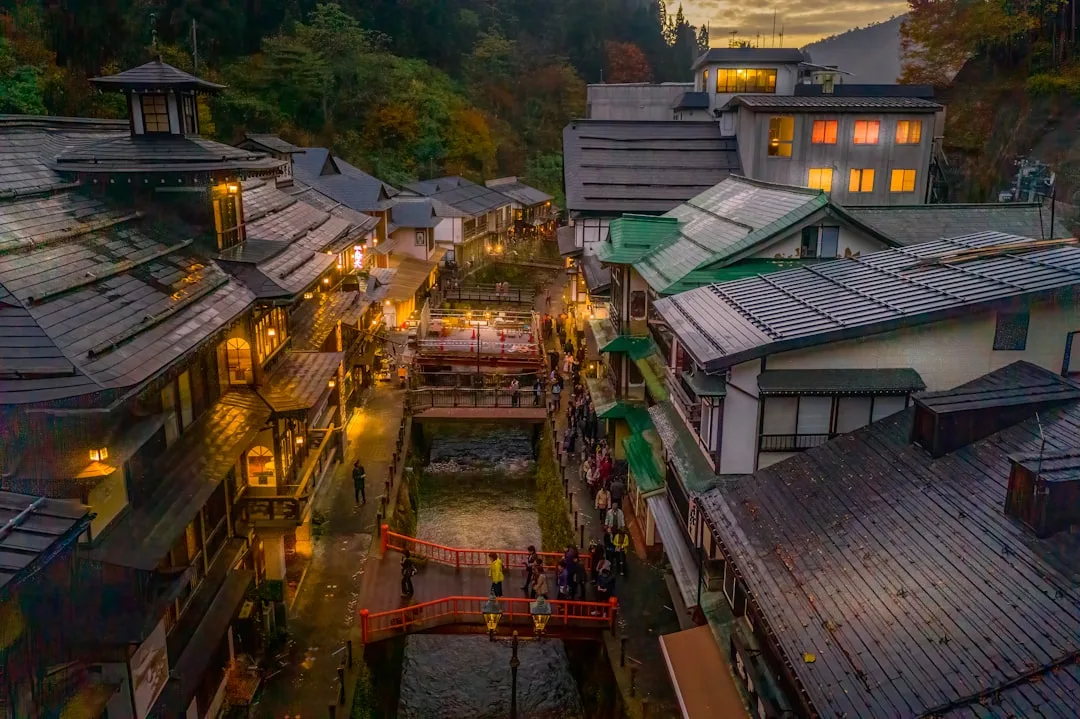
The onsen town that appeared on every travel list once it went viral in photographs: wooden Taisho-era bathhouses (1912–1926 architecture) lining a mountain stream, snow in winter, lanterns at night. It looks like a movie set. It is not — it is a working onsen town with about 20 ryokan.
The stream is the Ginzan River; the ryokan line both banks for about 300 meters. At night in winter, the snow, the lanterns, and the steam create the scene that circulates on every Japan travel account.
Access: 2.5 hours from Yamagata Station by bus (Yamagata is 1.5 hours from Tokyo by Shinkansen). Overnight required — the day trip crowds are significant; the overnight experience in an off-season week is something else.
Jigokudani (Nagano Prefecture)
Known internationally for the Japanese macaques (snow monkeys) that bathe in the thermal pools during winter. The monkeys have used the springs since the 1960s and the behavior has been passed down through generations.
Access: From Nagano Station, 45 minutes by bus to Kanbayashi Onsen, then 30-minute walk on a forest path (no cars allowed). The path through the forest in winter — snow on cedar branches, steam visible from a distance, sound of the river — is part of the experience before you even see the monkeys.
The monkeys bathe in the springs from roughly November through March. In summer they are present but without the famous bathing behavior. Admission ¥800.
The Shibu Onsen town at the start of the walk has 9 public bathhouses (visitors staying at a participating ryokan get a key to all nine), excellent soba restaurants, and a night atmosphere that is separate from the monkey tourism.
What to Pack and Expect
Most ryokan provide yukata, towels (large and small), and toiletries. You do not need to bring anything specific for a ryokan stay.
For day-use onsen, bring a small towel or rent one (¥100–300). Some facilities sell disposable razor and comb kits.
Bring water. The heat is significant; dehydration is common. Most onsen facilities have water dispensers outside the bath area.
Eat before or well after bathing, not immediately before — the combination of heat and a full stomach is unpleasant.
Bathing in Japan is not relaxation as performance. It is genuinely restorative in a physical sense — the heat, the minerals, the transition from outdoor cold to hot water, the ritual of washing before entering — and the culture built around it has refined the experience over centuries. You will emerge from a good onsen in a state of physical well-being that is difficult to describe to someone who hasn’t experienced it.
Find a ryokan with an outdoor bath, go in the morning before breakfast when the air is cold and the water is 42°C, and understand why this country built its culture around it.
Plan your trip