Japan's Best Onsen Towns: Beyond Hakone
Plan your trip
Japan has the highest concentration of geothermal activity of any inhabited country in the world — over 27,000 registered hot springs in all 47 prefectures. The culture that has grown around this geology — the onsen (bathing) tradition, the ryokan (inn) system designed around it, the specific etiquette and ritual of the communal bath — is one of the most distinctive aspects of Japanese life.
The famous onsen destinations (Hakone, Beppu) are excellent but heavily visited. This guide focuses on the towns that offer the most complete onsen experience — places where the hot spring is not a hotel amenity but the organizing principle of the entire settlement.
Kusatsu (草津) — Gunma Prefecture
Japan’s most celebrated onsen town by domestic ranking — the onsen dai-ichi (“number one hot spring”) of Japanese popular tradition. Kusatsu’s sulfuric spring is the hottest naturally occurring hot spring in Japan at 95°C at the source, requiring cooling before bathing.
The Yubatake (湯畑): The centerpiece of Kusatsu is the yubatake — a wooden-channeled field in the center of town where hot spring water flows across large wooden boards to cool, depositing yellow sulfur crystals on the wood. This is simultaneously the cooling mechanism for the spring and the symbol of the town. The yubatake steams constantly; at night, it is lit and the steam catches the light in the cold mountain air.
Bathing: Kusatsu’s spring is strongly sulfuric and highly acidic (pH 2.1) — known as kiku no yu (chrysanthemum hot water). The water is bactericidal and reputedly effective for skin conditions; the acidic quality means it burns slightly on open cuts. Maximum immersion time is typically 3 minutes for the hottest baths (jikan-yu).
The Jikan-yu (時間湯): A traditional bathing method specific to Kusatsu — a coordinator leads the bathers in vigorous water-paddling to cool the surface, then signals immersion for exactly 3 minutes. The ritual is performed at the Otakinoyu communal bath; it’s free to observe and ¥600 to participate.
Public baths: Kusatsu has 3 soto-yu (free public baths): Otakinoyu, Jizontyu, and Shokirinyu. No charge; bring your own towel.
Access: Highway bus from Shinjuku or Tokyo Station, approximately 3 hours. JR train to Nagano Harashokan then bus; 2.5 hours. No direct rail connection.
Season: Year-round, with late November–February the ski season (Kusatsu International Ski Resort adjacent). The snow-covered yubatake in winter is the most beautiful view.
Kinosaki Onsen (城崎温泉) — Hyogo Prefecture
Kinosaki is the soto-yu meguri (outdoor bath circuit) town — a village where the experience is walking in yukata (light cotton kimono) between 7 different public baths, each with a different spring character, alternating bathing with cold air walks along the willow-bordered canal.
The seven baths (nanasotoyu):
- Sato no Yu (さとの湯): The most modern, with multiple bath styles including indoor and outdoor
- Mandara Yu (まんだら湯): A 1,300-year-old bath said to be founded by a monk
- Gosho no Yu (御所の湯): Outdoors, with waterfall features; one of the most photographed
- Ko no Yu (鴻の湯): Set in a garden, the oldest-feeling of the seven
- Yanagi Yu (柳湯): Named for the weeping willow at the entrance; the smallest
- Ichi no Yu (一の湯): The largest and most central
- Jizo Yu (地蔵湯): Near the main temple; traditional character
The circuit: Check in to a ryokan, receive a yukata and the bath circuit ticket (typically included in accommodation or sold at the information center), and spend the afternoon-evening visiting 4–5 baths. The walk between them in yukata and wooden sandals (geta), through the willow canal street, past the ryokan frontages and small restaurants, is the Kinosaki experience.
Access: JR Kinosaki Onsen Station on the San’in Main Line. From Kyoto by Kounotori limited express: 2h20m. From Osaka, 2h45m. The train journey to Kinosaki from Kyoto passes through the Hyogo countryside and is pleasant.
Staying: Most visitors stay 1 night in a ryokan with full board (dinner and breakfast included). Price range: ¥15,000–40,000 per person with meals.
Ginzan Onsen (銀山温泉) — Yamagata Prefecture
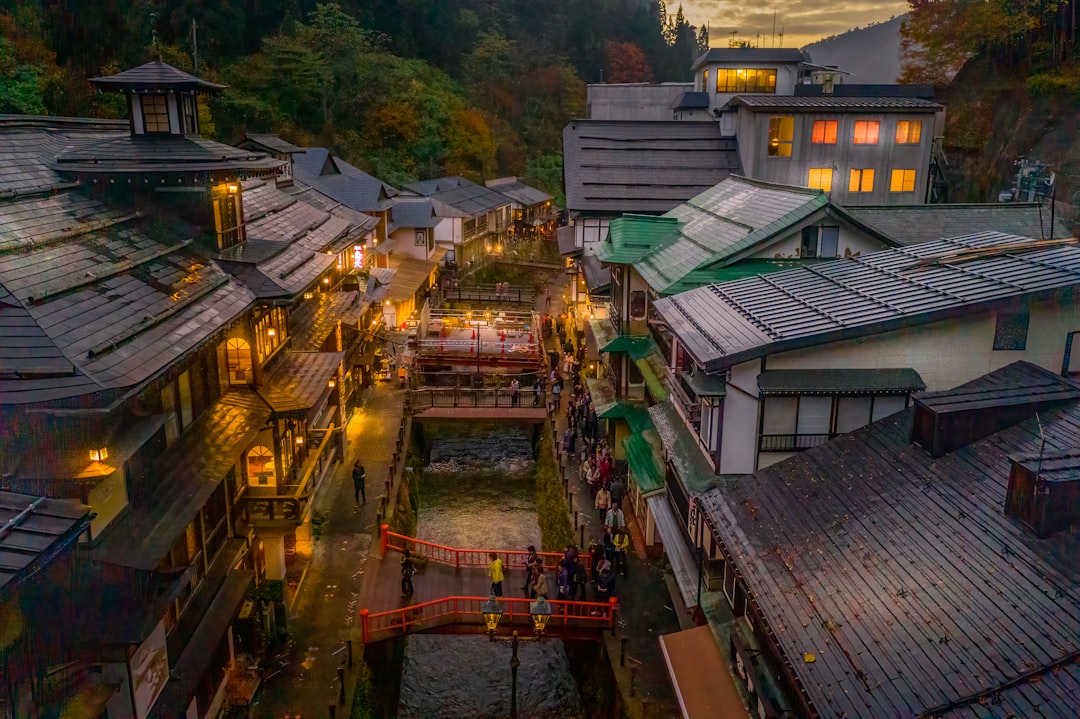
The most photographed onsen town in Japan — a narrow valley with Taisho-era (1912–1926) wooden Western-influenced ryokan buildings facing each other across a narrow stream, gas lamps lit at dusk, and in winter, snow piling on the overhanging eaves.
The name means “Silver Mountain” — a silver mine in the area declined after an onsen was discovered in the 1600s, and the town converted to bathing. The current townscape dates from the Taisho rebuilding after a 1913 flood; the two-story wooden buildings with their unusual hybrid Japanese-Western architecture give the town a specific aesthetic unavailable elsewhere.
Why it’s special: The valley is narrow enough that the two rows of buildings face each other at close range across the Ginzan River; the gas lamps at evening create a warm light in the steam and cold air that has made this the default image of “romantic Japanese onsen town” in marketing materials across the country.
Access: JR Yamagata Shinkansen from Tokyo to Oishida Station (2h45m), then bus to Ginzan Onsen (40 minutes). The total journey from Tokyo is approximately 3.5 hours.
Crowds and booking: Ginzan is heavily photographed but the town itself has limited accommodation capacity. Ryokan books out months in advance for winter weekends. Weekday stays are more available. The best window for photography is 4:30–6:30pm in winter when the lamps are lit and snow is fresh.
Day visitors vs. overnight: Day visitors can walk the main street and use some day-visit baths (check individual ryokan policies), but the gas-lamp evening is only available to overnight guests.
Nyuto Onsen — Tsurunoyu (乳頭温泉郷 鶴の湯) — Akita Prefecture
Japan’s most celebrated hinabitaonsen (rustic, remote hot spring) — a complex of wooden bath houses and thatched-roof accommodation in the mountains of Akita, with milky white spring water in an outdoor mixed-gender bath.
The spring: The outdoor konyoku (mixed-gender) rotenburo at Tsurunoyu is one of the most famous bathing images in Japan — a large outdoor bath of opaque white water surrounded by forest, steam rising in the cold air, an early morning mist over the scene. The white color comes from dissolved sulfur.
The accommodation: Staying overnight at Tsurunoyu requires booking well in advance — the thatched-roof traditional rooms are limited and famous enough that reservations fill months ahead for weekends. The experience includes meals of mountain cuisine (jizakana river fish, mountain vegetables, local sake) in the traditional building.
Access: JR Akita Shinkansen to Tazawako Station (2h30m from Tokyo), then bus to Nyuto Onsen area (50 minutes). Tsurunoyu is the furthest into the mountains of the Nyuto Onsen group — an additional 10-minute walk or taxi from the bus stop.
Day visit: Tsurunoyu accepts day visitors for the baths (¥600), but the morning before other guests arrive is the best window. Arrive early; the outdoor bath is most atmospheric at dawn and in cold weather.
Beppu (別府) — Oita Prefecture, Kyushu
Japan’s largest concentration of hot spring output — over 85 million liters per day from springs across the city. Beppu is less a single onsen town and more an onsen city, with the volcanic activity visible in every neighborhood.
The Hells (Jigoku Meguri): Eight dramatically colored thermal pools designated as public sights rather than bathing areas:
- Umi Jigoku (Sea Hell): Cobalt blue pool at 98°C
- Chinoike Jigoku (Blood Pond Hell): Red oxide spring, the most dramatic
- Tatsumaki Jigoku (Waterspout Hell): A geyser that erupts approximately every 30 minutes
- Shiraike Jigoku (White Pond Hell): Milky white, quieter
The hell tour ticket covers all 8 sites: ¥2,000.
Sand bathing (sunayu): At Beppu Onsen Hoyo Land or the beach at Beppu Hama, attendants bury visitors in naturally geothermally heated sand (40–45°C) for 10–15 minutes. Unlike typical onsen, no nakedness required (a cotton robe is provided). One of the most distinctive bathing formats in Japan.
Access: Oita Airport, 40 minutes by bus. Or Shinkansen to Kokura/Hakata, then express to Beppu (1h30m from Hakata).
Onsen Etiquette
The essentials apply across all onsen:
- Wash before entering: The shower stations before the bath are mandatory — onsen are for soaking, not washing
- No swimwear: Traditional communal baths require bathing without clothing (except where specifically noted as swimwear-permitted)
- Tattoos: Many traditional onsen prohibit visible tattoos (association with yakuza criminal culture); check policies before visiting. Some resort hotels with private baths are more flexible
- Small towel: A small towel is used in the bathing area but not submerged in the bath water; the large towel is for drying after
- Hair up: Long hair should be tied up to avoid it touching the water
- Quiet: The bath is not a social space for loud conversation
Private baths (kashikiri-buro): Many ryokan offer bookable private baths for groups or couples — same water quality, no nakedness concerns. The premium over the public bath is ¥1,500–4,000/hour.
Plan your trip