Off the Beaten Path Japan: 10 Places Beyond Tokyo and Kyoto
Plan your trip
Japan’s tourist infrastructure is so good, so well-translated and so thoroughly documented that it’s possible to do a two-week trip and never feel like you’ve discovered anything. The Golden Route — Tokyo, Kyoto, Osaka — is polished to a shine. Every photo opportunity is marked. Every food recommendation is on Google Maps with an English menu.
That’s not a criticism. Those places are popular because they’re extraordinary.
But Japan has a second layer. Places where the English signs thin out. Where the tourists are Japanese tourists on a weekend trip, not international visitors checking boxes. Where something happens that you didn’t read about and can’t quite explain afterward.
Here are ten of them.
1. Kanazawa
Kanazawa is the one on this list you should go to first. It’s not exactly hidden — Japanese travelers have always known about it — but the international tourist traffic is a fraction of Kyoto’s, and the reward is a city that feels genuinely preserved rather than performed.
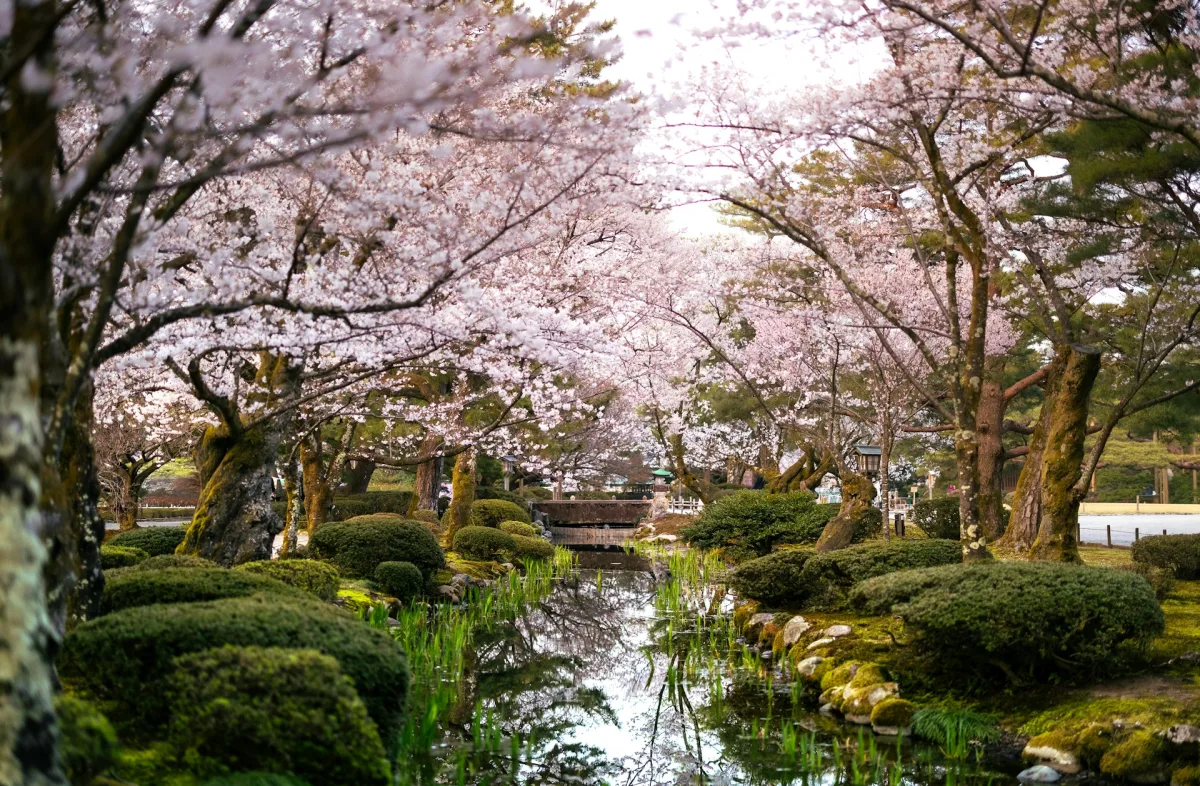
The Higashi Chaya geisha district has the same DNA as Kyoto’s Gion but without the crowds. Walk it at 7am and it’s yours. The Kenroku-en garden is considered one of Japan’s finest — the pine trees propped up with wooden supports against the winter snow weight are one of those things that makes you stop walking.
And the food: Kanazawa is one of Japan’s great food cities, built on fresh seafood from the Sea of Japan coast. Omicho Market is where to start.
Getting there: Hokuriku Shinkansen from Tokyo, 2h30m.
2. Tohoku — Japan’s Forgotten North
The Tohoku region — six prefectures north of Tokyo on Honshu’s spine — was bypassed by mass tourism partly because of the 2011 tsunami (which devastated the coastal areas but left the inland mountains untouched) and partly because it doesn’t fit neatly onto the standard itinerary.
What you get instead: near-empty onsen towns, ancient forest walking routes (the Michinoku Coastal Trail runs 700km along the coast), autumn foliage that rivals Kyoto’s but without the crowds, and local festivals that feel like they’re being held for the people who live there, not for you.
Highlights:
- Matsushima: 260 pine-covered islands in a bay, considered one of Japan’s three most scenic views
- Yamadera: a temple complex built into a mountain cliff, accessed by 1,000 stone steps
- Ginzan Onsen: a hot spring town that looks exactly like the setting of a Studio Ghibli film — because one of them was loosely based on it
Getting there: Tohoku Shinkansen from Tokyo. Yamagata and Sendai are the main hubs.
3. Shikoku and the 88-Temple Pilgrimage
Shikoku is the smallest of Japan’s four main islands, and the least visited by foreigners. The island is best known for the 88-temple pilgrimage circuit — a 1,200km walk that takes 40–60 days to complete. People have been doing this pilgrimage for over 1,000 years. Many still do.
You don’t have to walk all 88 temples. But driving or cycling portions of the route, staying at the temple lodgings (shukubo) and eating the simple pilgrim meals is one of the most distinctive travel experiences Japan offers.
Highlights:
- Matsuyama: a city with one of Japan’s few surviving original castles and the finest traditional onsen town (Dogo Onsen, Japan’s oldest)
- Iya Valley: a remote mountain valley accessible only by a narrow road, with vine bridges suspended over gorges — a place of extraordinary isolation
- Kochi: a city famous for its food culture and the only castle in Japan built with the original tower
Getting there: fly from Tokyo or Osaka, or take the Shinkansen to Okayama then cross by bridge.
4. Yakushima
Yakushima is an island covered in ancient cedar forest, some of the trees over 7,000 years old. The forest was the visual reference for Princess Mononoke. It rains constantly — about 4 meters per year — which keeps it green and misty and quiet in a way that Japan’s cities are not.
The Jomon Sugi, a cedar estimated to be between 2,000 and 7,200 years old, requires an 8-10 hour round-trip hike. Most people who do it don’t regret it.
Yakushima is a 3-hour ferry from Kagoshima or a short flight. Go for 2–3 nights minimum.
5. Naoshima — Art Island
In the Seto Inland Sea, Naoshima is a small island that became an unlikely destination through art. Starting in the 1990s, the Benesse Foundation built a series of museums designed by architect Tadao Ando — concrete buildings that integrate with the landscape, displaying contemporary art by Yayoi Kusama, James Turrell and others.
The combination of traditional fishing village, contemporary architecture, and art that fills whole rooms with nothing but light and reflection is unlike anything else in the country.
Two days is enough. Rent a bicycle.
6. Shirakawa-go
A UNESCO World Heritage village in the mountains between Nagoya and Kanazawa, Shirakawa-go consists of farmhouses with extraordinarily steep thatched roofs — designed to shed the heavy mountain snowfall. In winter, with snow on the roofs and light in the windows, it looks like it was drawn rather than built.
Visit for a half-day from Kanazawa or Nagoya. If you can stay overnight at a gassho-zukuri farmhouse, the village in the early morning before the day-trippers arrive is genuinely moving.
7. Kinosaki Onsen
A small hot spring town on the Sea of Japan coast, Kinosaki is the template for the traditional onsen experience. The town has seven public bathhouses; you stay at a ryokan, put on a yukata (cotton kimono), collect your wooden sandals, and walk from bath to bath through the lantern-lit streets in the evening.
It’s as Japanese as anything gets. Two nights here will rearrange your understanding of what relaxation is.
Getting there: Limited Express from Osaka, about 2.5 hours.
8. Aizuwakamatsu
In Fukushima Prefecture (which is overwhelmingly safe and beautiful and largely avoided due to lingering post-2011 anxiety that has no basis in fact outside the immediate exclusion zone), Aizuwakamatsu is a castle town with a story that cuts deep.
In 1868, during the Boshin War that ended the samurai era, the castle was besieged by imperial forces. A group of young samurai — the Byakkotai (White Tiger Force), boys aged 16–17 — climbed a nearby hill during the battle, saw smoke rising from the direction of the castle, and believing it had fallen, committed ritual suicide. The castle had not, in fact, fallen. The graves are still there.
The story has an unbearable quality to it. Walking through Aizuwakamatsu, visiting the castle and the hill, does something to you.
9. The Nakasendo Trail
Between Tokyo and Kyoto, there are two historic roads. The Tokaido (the coastal route, now largely the Shinkansen corridor) is famous. The Nakasendo (the mountain road through the interior) is not.
The most walkable section runs between the post towns of Magome and Tsumago — 8km through cypress forest, past old inns and farmhouses unchanged since the Edo period. Most people do it as a day hike (3 hours); you can also stay overnight in one of the historic post town inns.
Post town Japan — the way things looked when foot travelers and merchants moved slowly along these roads — is something you understand in your body when you walk it.
10. Kyushu’s Onsen Country
Beppu and Kurokawa — two onsen towns on the southern island of Kyushu — represent the extreme end of Japan’s hot spring culture. Beppu has the highest volume of hot spring water in the world outside Iceland; the town literally steams. The “hells” (jigoku) — boiling ponds in vivid colors, red and blue and white — are alien-landscape spectacles.
Kurokawa is the quieter version: a small village of ryokan in a mountain valley, each with open-air baths set into the rocks, some carved into cliffside, some extending over the river. Stay two nights. Leave wondering what you were stressed about before you arrived.
How to Find These Places
The pattern: take the main Shinkansen lines, then branch off. The trunk routes connect the Golden Route cities. The branch lines and local trains lead to everywhere else.
Don’t over-plan. Japan rewards the traveler who leaves a day or two unscheduled and asks a ryokan owner or a konbini (convenience store) worker where to go. The answer is never what the guidebooks say.
Plan your trip